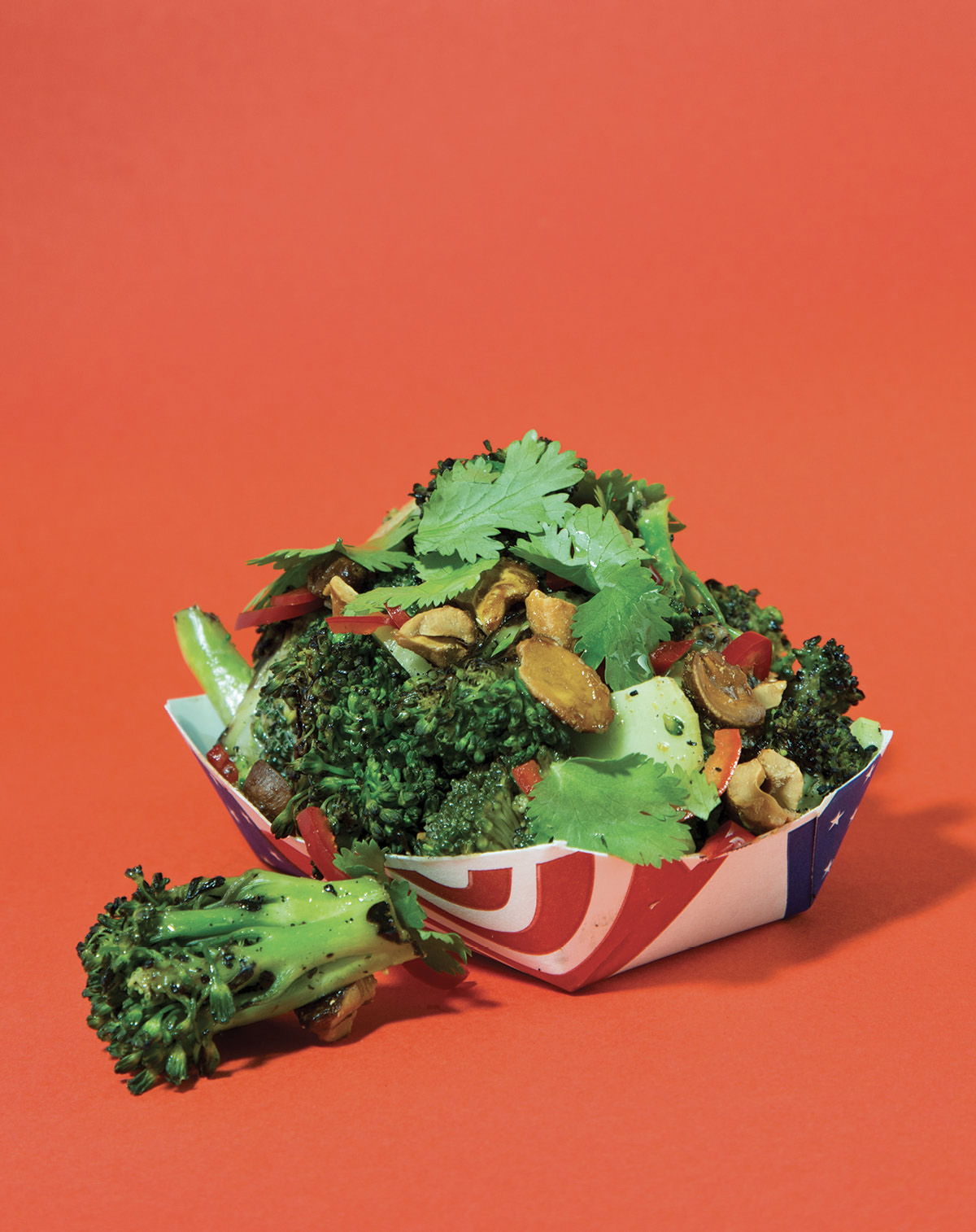
This was our first salad. It’s on the main menu and never leaves. There are multiple steps, but the end result is worth it. Initially it was a fish sauce–less take on a Thai-style green papaya salad that strayed so far from the original it no longer resembled anything remotely stolen. A very dry cast-iron skillet on high heat will burn your broccoli nicely (no oil though, as it will ignite immediately).
Makes 2 cups
2 tablespoons coriander seeds, toasted
¼ cup water
½ cup seasoned rice wine vinegar
Juice of 1 lime
½ cup extra virgin olive oil
Finely grind the coriander seeds in a spice grinder, coffee grinder, or mortar and pestle. Mix the ground-up seeds with the water in a medium bowl. Add the rice wine vinegar and lime juice and mix to combine. Slowly whisk in the olive oil.
Makes 2 cups
2 Japanese eggplants
¼ cup extra virgin olive oil, plus more for drizzling
2 tablespoons malt vinegar
1 tablespoon maple syrup
1 tablespoon smooth tahini
Preheat the oven to 375ºF.
Cut the eggplants in half lengthwise and place on a baking sheet with the skin directly touching the pan. Drizzle a little olive oil over the inner flesh and season with a little salt and pepper. Cook the eggplants in the oven until lightly browned and fully tender, about 30 minutes. Let cool.
Put the eggplants, including the skin, into the bowl of a food processor (or use an immersion blender). Add the malt vinegar, maple syrup, and tahini to the bowl. With the motor running, stream in the olive oil. Add salt and pepper as needed. If the puree is too thick, add a little water and blend a bit more.
Makes 2 cups
2 cups roasted unsalted cashews
3 tablespoons simple syrup
½ cup turbinado sugar
1 teaspoon kosher salt
Preheat the oven to 325ºF. Line a baking sheet with parchment paper.
Toss the cashews with the simple syrup in a medium bowl until lightly coated. There should not be liquid in the bottom of the bowl. Sprinkle the sugar and salt all over the nuts and toss to coat. Spread the nuts out into a single layer on the baking sheet. Bake until the cashews begin to toast and the sugar becomes glossy, about 15 minutes. Let cool and roughly chop. This method of simple syrup and turbinado sugar and salt can be used for candying just about anything—sunflower seeds, coconut, corn chips . . .
BURNT BROCCOLI SALAD
serves 6
2 bunches broccoli, florets separated from the stems, stems peeled and shaved lengthwise on a mandoline
2 Fresno chiles, cut in half lengthwise, seeded, and thinly sliced
1 tablespoon cane sugar
1 teaspoon kosher salt
½ cup white wine vinegar
Fresh cilantro leaves
Heat a dry medium cast-iron skillet over high heat. Cook the broccoli florets, tossing occasionally, until the surfaces are blackened, 10 to 15 minutes. Transfer to a large plate and let cool.
Toss the chiles, sugar, and salt in a small bowl. Let sit for a few minutes, until the juices release, then add the white wine vinegar.
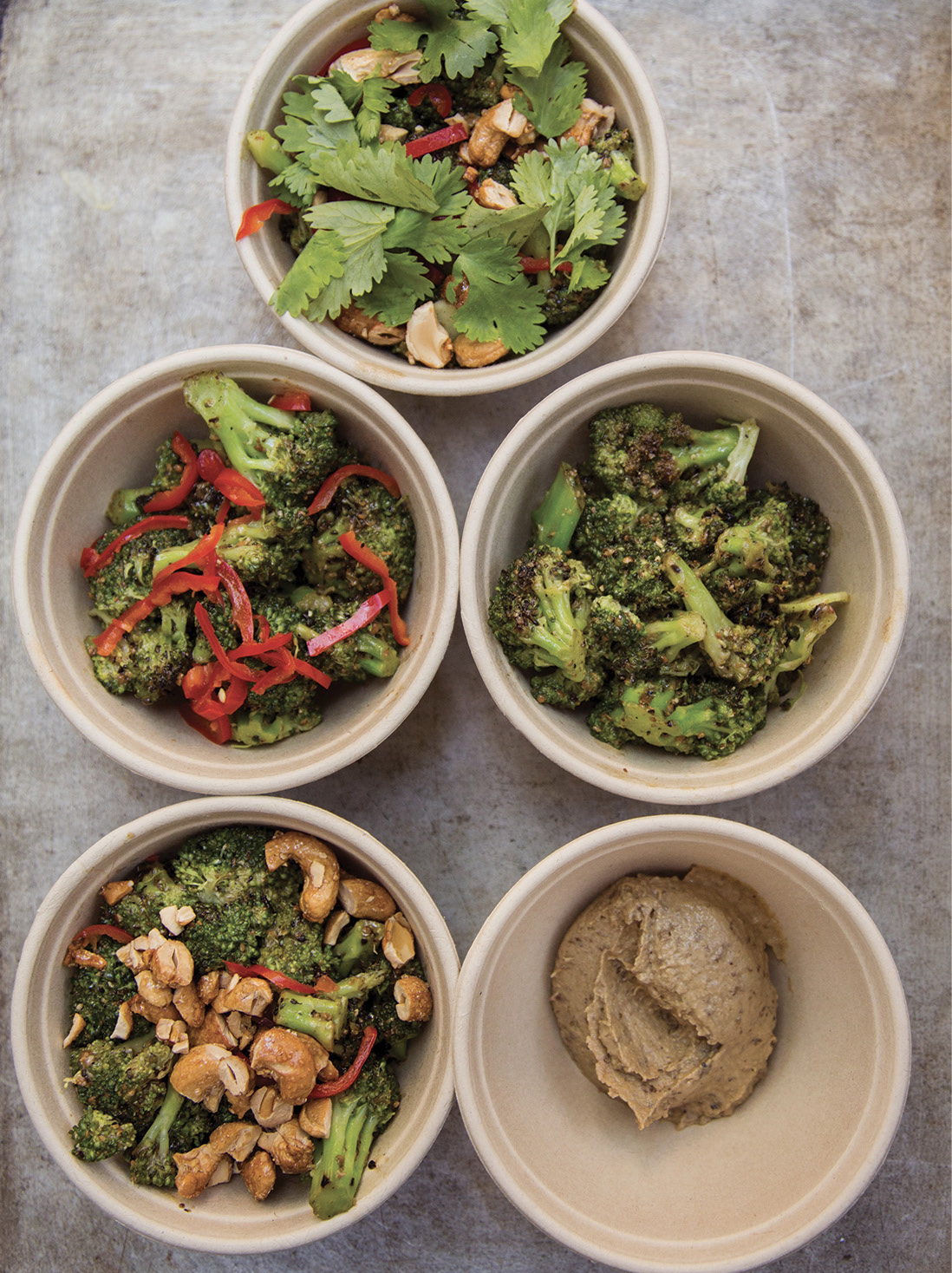
To serve, toss the charred broccoli florets, the broccoli stems, and ½ cup of the coriander vinaigrette in a large bowl. Serve over the eggplant puree topped with chopped candied cashews, cilantro leaves, and drained Fresno chiles.
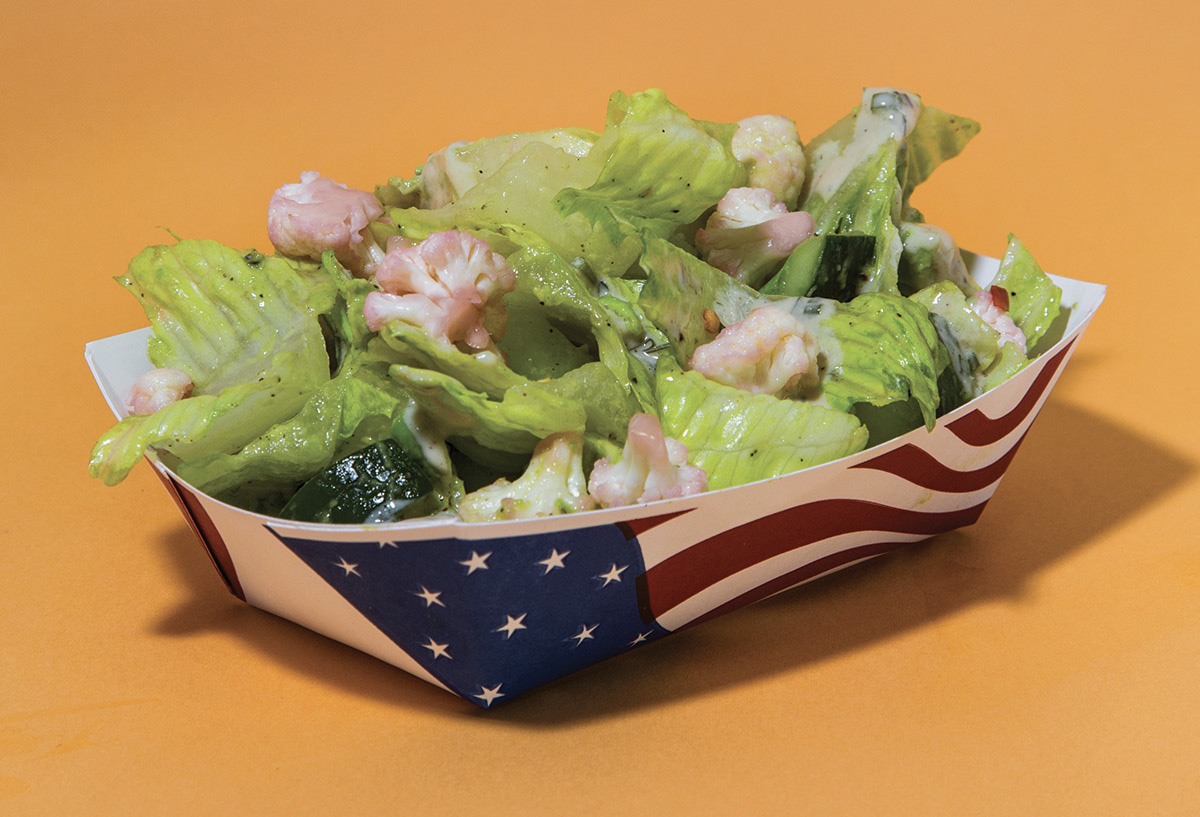
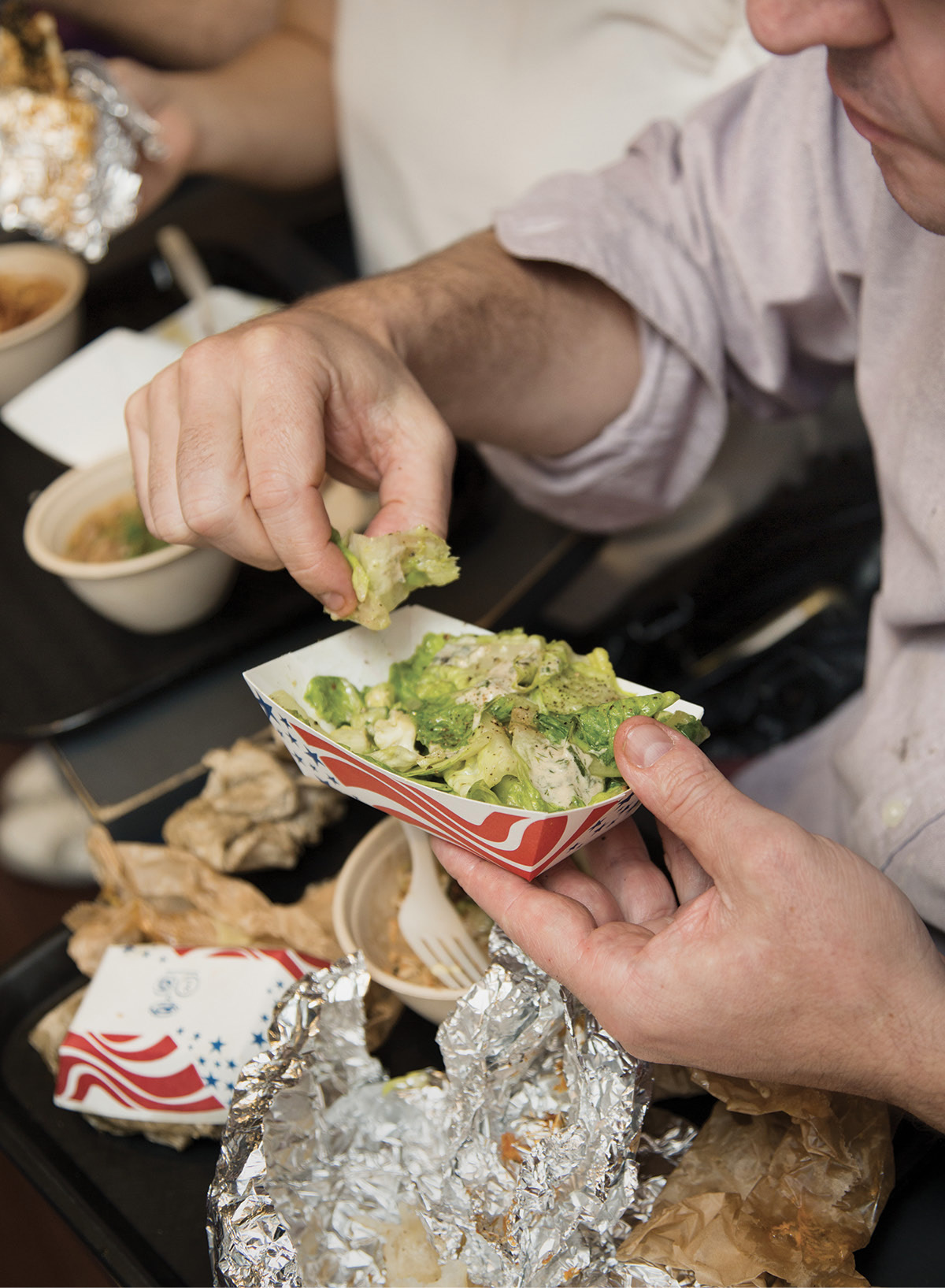
Our pastry chef used to work for a guy who claimed that all anyone really wants when they go out to eat is a steak and a Caesar salad. This guy is kind of a knucklehead, but he might be right, at least about the Caesar salad part. This is our vegan version. It’s as salty as a bag of pretzels and, we like to think, as satisfying as a rib eye.
Serves 6
TAHINI RANCH DRESSING
1 cup smooth tahini (we use Soom)
½ cup water
½ cup fresh lemon juice
⅓ cup each chopped fresh flat-leaf parsley, dill, and chives
½ teaspoon garlic powder
2 tablespoons maple syrup
1 tablespoon extra virgin olive oil
BREAD AND BUTTER CAULIFLOWER
1 head cauliflower, cut into small florets
2 cups cider vinegar
1½ cups cane sugar
3 tablespoons kosher salt
1 green bell pepper, thinly sliced
1 medium red onion, thinly sliced
1 ripe avocado, pitted and skin removed
3 heads romaine lettuce, cut into 1-inch pieces
1 English cucumber, cut into medium dice
Nice olive oil
For the tahini ranch dressing, mix the tahini, water, and lemon juice in a bowl until smooth. Add more water if needed to get a smooth consistency. Add the chopped herbs, garlic powder, and maple syrup, and season with salt and black pepper. Ideally, let sit overnight to allow the flavors to come together.
For the bread and butter cauliflower, put the florets in a large bowl or heat-safe container with at least 2 inches of room at the top. Combine the cider vinegar, sugar, and salt in a saucepan. Add the sliced bell peppers and onions to the saucepan and bring to a boil over high heat. Once boiling, pour the liquid—including the peppers and onions—over the cauliflower. Check the seasoning for salt and sugar. Let sit for at least 30 minutes before using. These will stay good refrigerated for a couple weeks.
To assemble the salad, smash up the avocado in the bottom of a large bowl. Add the romaine, a handful of cauliflower, the chopped cucumbers, a splash of olive oil, a splash of the cauliflower pickling liquid, and salt and black pepper. Using your hands, toss the lettuce so that the leaves are well coated with avocado-y goo. Serve with little dots of the ranch dressing. It doesn’t need too much.

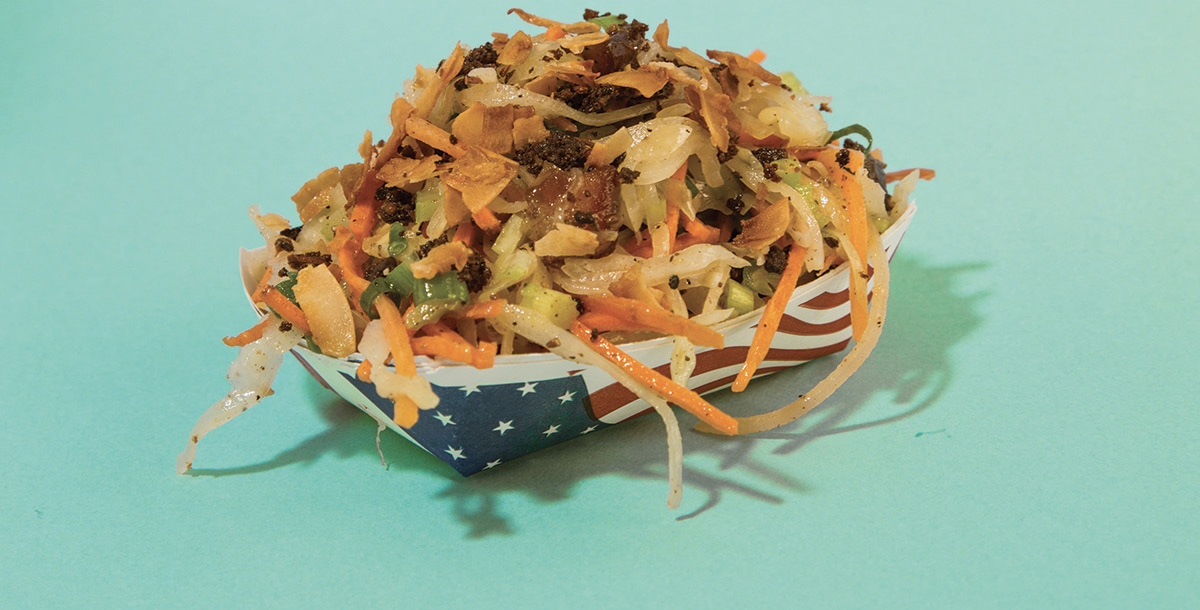
This is our version of a carrot and raisin salad, the type found at the pickle bar at the Silver Spring, MD, inimitable Parkway Deli. There’s sweetness in the form of hacked-up dates and an underlying breadiness from the caraway vinaigrette. You can make it in advance and just let it stew in its own juices, flicking the dry stuff on top at the last minute.
Serves 6
CARAWAY VINAIGRETTE
2 teaspoons Dijon mustard
1 tablespoon maple syrup
1 cup cider vinegar
2 tablespoons caraway seeds, toasted and partially ground
1½ cups grapeseed oil
1 head green cabbage, shredded
2 teaspoons kosher salt
2 teaspoons cane sugar
2 carrots, shredded
2 celery stalks, cut into small dice
2 scallions, thinly sliced
4 juicy dates
¼ cup unsweetened coconut flakes, toasted
¼ cup toasted rye bread crumbles
For the caraway vinaigrette, mix together the mustard, maple syrup, cider vinegar, and a good pinch of salt in a bowl. Add the caraway seeds. Drizzle in the grapeseed oil while whisking. Add more salt if needed. This dressing should be quite acidic.
Toss the cabbage with the salt and sugar in a large bowl. Transfer the cabbage to a large colander set over a bowl and let drain for at least 30 minutes. Rinse the cabbage with cold water and wring it out in a clean dish towel until very dry. Transfer to a large mixing bowl. Add the carrots, celery, and scallions to the bowl and toss to combine. Remove the pits from the dates—if they have pits—and tear the dates into small pieces while adding them to the slaw mix. Dress with the caraway vinaigrette, salt, and pepper. Serve topped with a sprinkle of toasted coconut and rye bread crumbles.
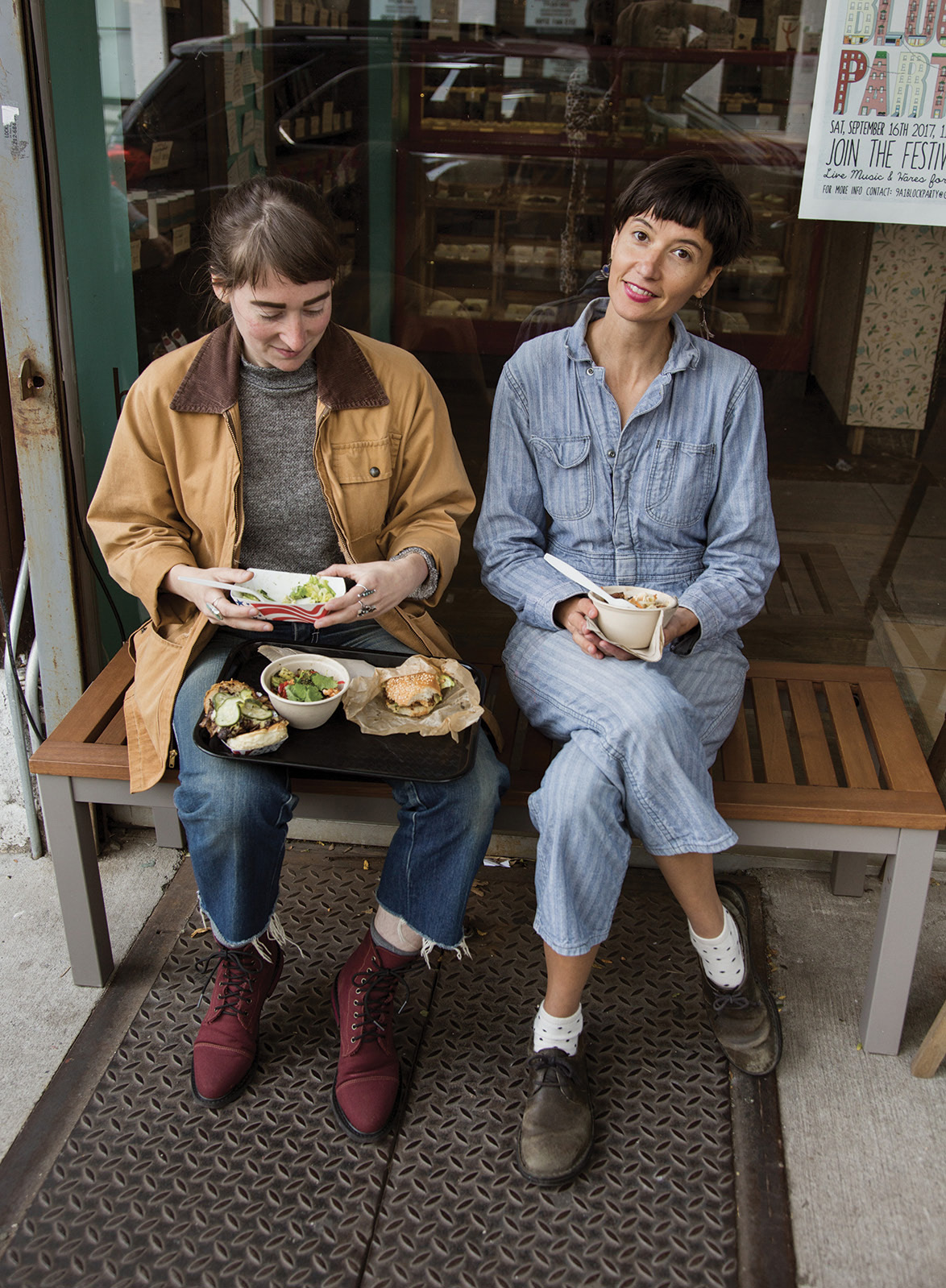
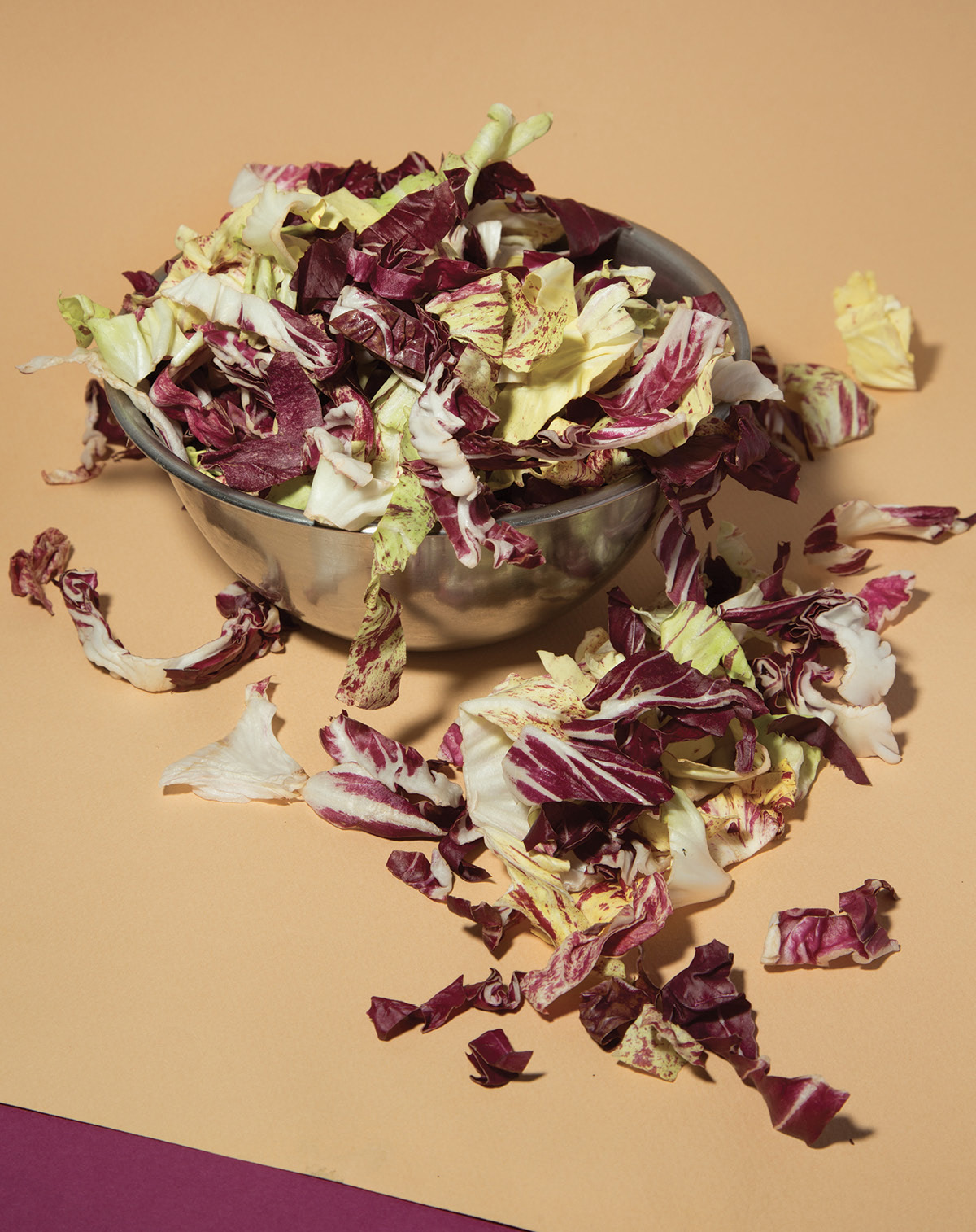
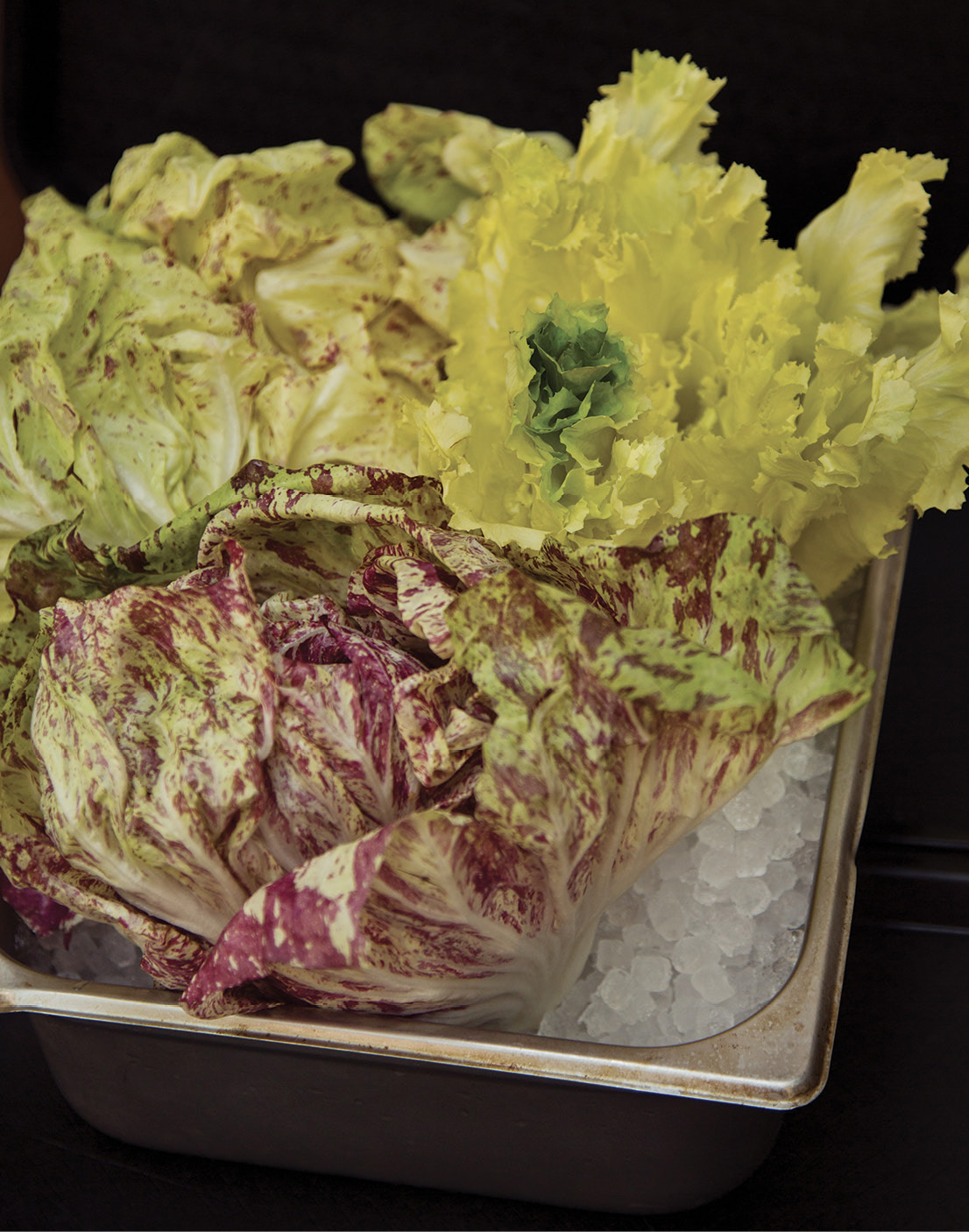
Campo Rosso Farm, based in Pennsylvania, is owned by Jessi Okamoto and Chris Field. They sell their vegetables at New York City’s Union Square farmers’ market only on Fridays, and while their tomatoes in July are unfathomably perfect, the chicories (Castelfranco, radicchio, endive, frisée) that fill their table during the autumn months are better than anything we’ve ever had (even in Friuli). The couple is a little weird (in a good way) and slightly psychotic about the vegetables they grow, so we became fast buddies right when Superiority opened up. This salad utilizes the same caraway vinaigrette as the previous slaw, but is balanced differently by the cough syrup–like bitterness of the chicory leaves. This one is very easy.
Serves 6
3 heads chicory greens (such as Castelfranco, radicchio, endive, or frisée)
½ head green cabbage, shredded
2 nice tart apples, such as Granny Smith, thinly sliced
Pickled Red Onions (page 204)
Caraway Vinaigrette (page 56)
1 cup toasted chopped almonds
Chop up the chicories into about 1-inch pieces and put into a large bowl along with the cabbage. Toss in the apples and a small handful of the pickled onions. Dress with the caraway vinaigrette and season with salt and pepper. Serve with some toasted almonds on top.
GREEN BROWN RICE WITH YELLOW BEETS
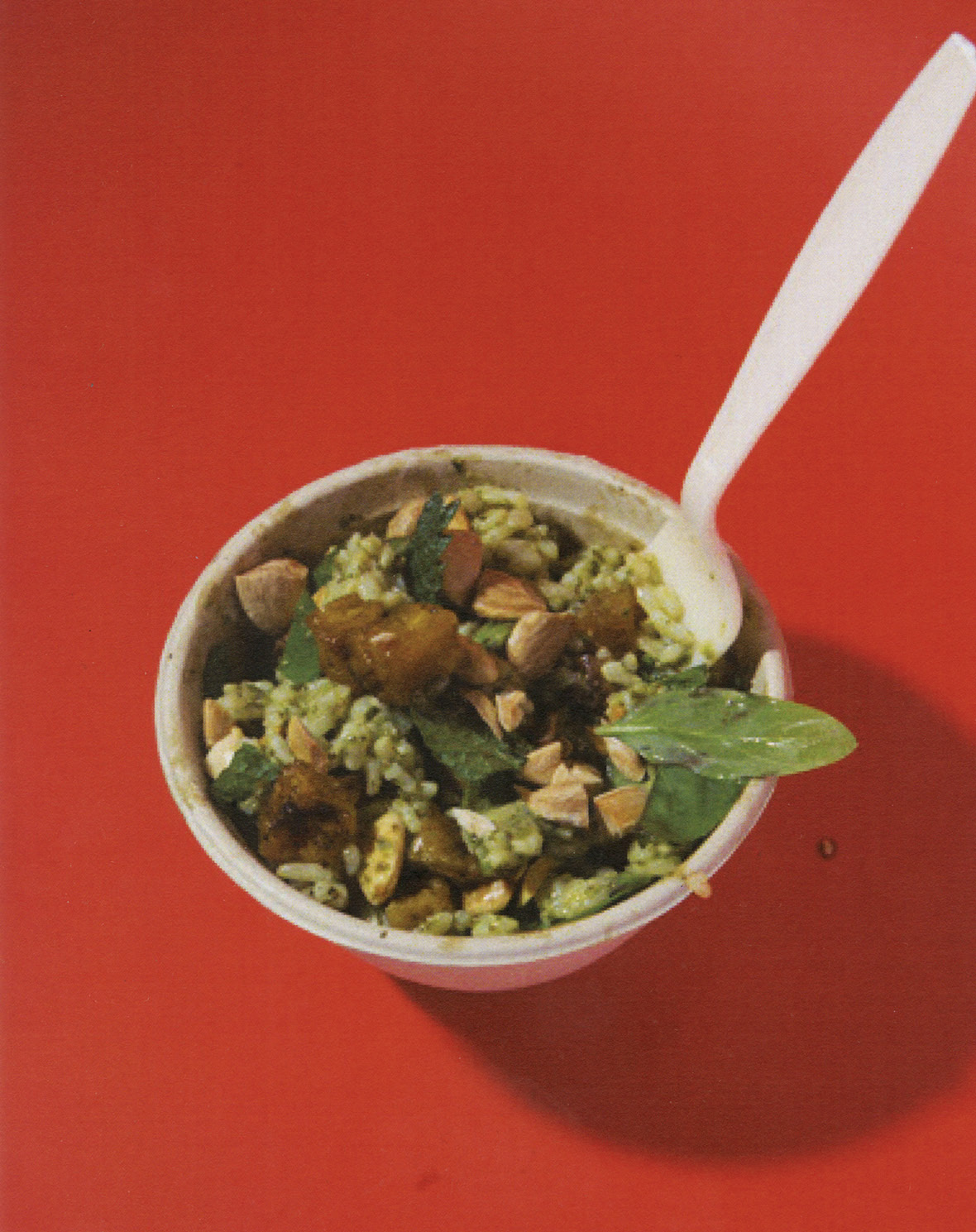
A lot of things in life prove the adage that the sum is greater than its parts. Spaghetti al pomodoro, the 1983 Baltimore Orioles, the first couple Devo records, the cast of The Jerk, a good 3 a.m. NYC deli BLT, these all come to mind. This salad pops up almost too much on our specials board. There’s an illegitimate green goddess dressing that flirts with a pesto milieu while staying very much on the outskirts, and yellow beets that flagrantly ignore their inherent earthiness. If you can find some Thai basil to throw on top, its usual cinnamony quality will be downplayed by the other components in a sum that is greater than the parts.
Serves 4
GREEN DRESSING
4 scallions, cut into ½-inch pieces
2 cups fresh Thai basil leaves
1 cup fresh Italian basil leaves
1½ cups fresh mint leaves (shiso is nice too, if it’s available)
1 cup fresh flat-leaf parsley (stems are fine)
1½ cups Chickpea Mayo (page 211)
3 large yellow beets, peeled and cut into 1-inch cubes
Extra virgin olive oil
1 cup seasoned rice wine vinegar
Juice of 2 limes
2 cups cooked brown rice (page 211)
Crushed red pepper flakes
½ cup marcona almonds, toasted and chopped
Fresh Thai basil/Italian basil/mint
To make the green dressing, either in a very hot dry pan or under the broiler, char the scallions until deeply browned and tender. Set aside to cool off. In a food processor or with an immersion blender, blend all the herbs with the mayo and charred scallions until a smooth dressing forms. Thin with water if needed. Season with salt and black pepper.
Preheat the oven to 375ºF. Line a baking sheet with parchment paper.
Toss the beets with a little olive oil, salt, and black pepper and spread out into a single layer on the baking sheet. Bake the beets until they are tender and begin to brown a little at their edges, 20 to 30 minutes. While the beets are in the oven, mix together the rice wine vinegar and lime juice in a medium bowl. Once the beets are done, immediately toss them while they are very hot into the vinegar mixture. Let them sit for at least 30 minutes.
In a medium bowl, gently mix together brown rice, ¼ to ½ cup green dressing, and a big pinch of red pepper flakes until the rice is well dressed. Add the drained pickled beets and a tablespoon or two of the beet pickling liquid to the bowl and stir to combine. Top with the chopped marcona almonds and scatter torn bits of basil and mint over everything. Serve at room temperature or, if on a particularly hot day, slightly chilled.
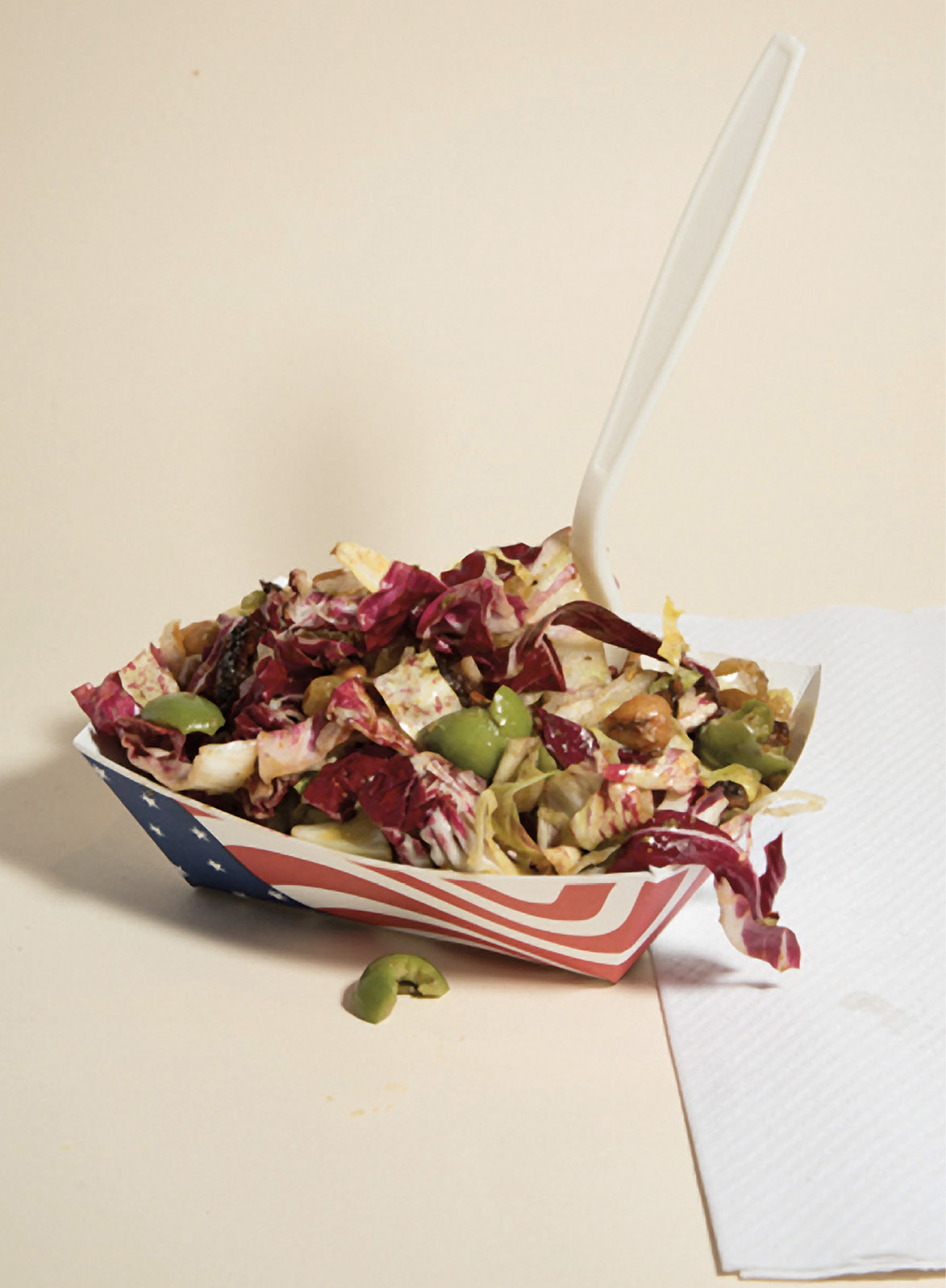
The inner workings of this salad were blatantly ripped off of the chopped salad served at Pizzeria Mozza in Los Angeles. However, by eliminating the cured shredded meat and provolone cheese, and tweaking Nancy Silverton’s masterpiece of a dish into something totally vegan, we feel strongly that this is not out-and-out robbery. Lawyers will have to hash this one out in a boardroom somewhere.
Serves 6
OREGANO VINAIGRETTE
2 garlic cloves
3 tablespoons nice dried oregano
Juice of 2 lemons
⅓ cup red wine vinegar
1¼ cups extra virgin olive oil
ROASTED CHICKPEAS
One 15-ounce can chickpeas, drained
2 tablespoons extra virgin olive oil
3 tablespoons tomato sauce
1 tablespoon red wine vinegar
2 teaspoons smoked paprika
1 teaspoon Korean chile flakes
1 tablespoon fennel seeds, toasted
1 tablespoon nutritional yeast flakes
1 tablespoon fennel seeds, toasted
2 garlic cloves, minced
1 head iceberg lettuce, shredded
2 small heads radicchio, thinly sliced
¾ cup Hammered Mushrooms (page 207)
¼ cup sliced pepperoncini
¼ cup Pickled Golden Raisins (page 205)
¼ cup sliced Castelvetrano olives
For the oregano vinaigrette, put the garlic, oregano, and lemon juice in a blender and blend on high until everything is pulverized. Add the red wine vinegar and salt and black pepper and blend to combine. With the blender running, stream in the olive oil.
Preheat the oven to 325ºF. Lightly grease a baking sheet with olive oil.
To make the roasted chickpeas, toss the chickpeas with the olive oil, tomato sauce, red wine vinegar, paprika, chile flakes, yeast flakes, fennel seeds, garlic, and salt and black pepper in a medium bowl. Check the seasoning—the mixture should be intensely seasoned. Spread the chickpeas into a single layer on the baking sheet. Bake until the chickpeas are mostly dry on the outside but still tender on the inside, 35 to 40 minutes. Let cool.
Mix together the iceberg lettuce and radicchio in a large salad bowl. Add the mushrooms, pepperoncini, raisins, olives, and chickpeas and toss, making sure to disperse every component evenly. Right before serving, dress the salad with the oregano vinaigrette—4 tablespoons or so—and season with salt and black pepper if needed. Serve immediately.
VARIATION
ANTIPASTO PASTA SALAD
For a more substantial version of this salad, add a 1-pound box of cooked and cooled pasta (we use De Cecco gnocchi shape, but shells or penne would work nicely) to the lettuce mix. The rest of the assembly is the same.
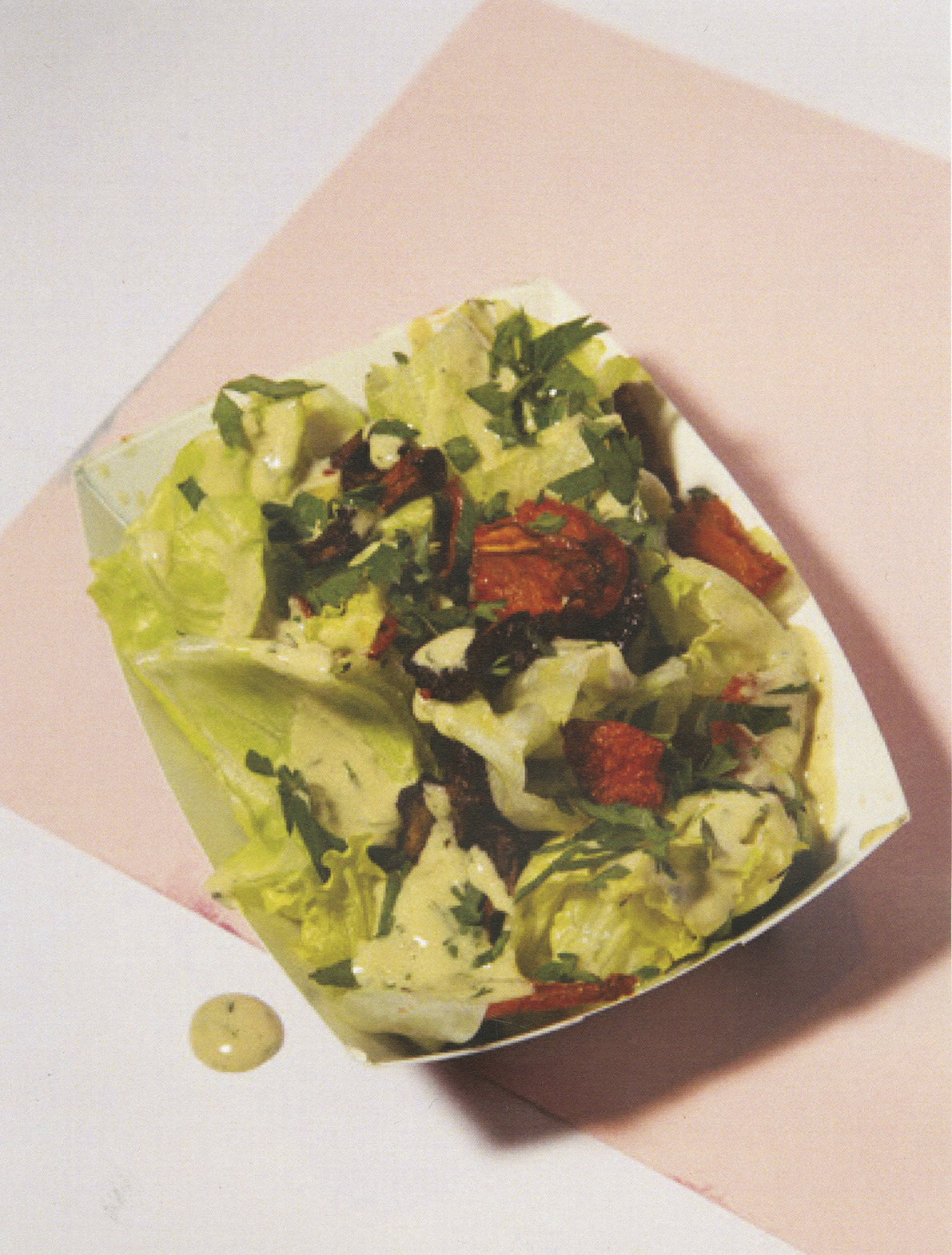
A wedge salad is always pretty okay in our book. This is our version, and, surprise, yes, it’s void of animal products (imagine that). We also shred the iceberg rather than gobbing a dressing to run down all over a quarter hunk of compacted lettuce. Mushrooms are the bacon and the tomatoes are the tomatoes.
Serves 4 to 6
WEDGELESS DRESSING
1 cup tahini
Juice of 2 lemons
½ cup water
1½ teaspoons maple syrup
½ teaspoon toasted sesame oil
1 head iceberg lettuce, cut into irregular bite-size triangles
½ cup Roasted Red Tomatoes (page 71)
½ cup Hammered Mushrooms (page 207)
Chopped fresh flat-leaf parsley
For the wedgeless dressing, mix the tahini, lemon juice, and water in a bowl until smooth. Add more water if needed to get a smooth dressing. Add the maple syrup and sesame oil. Season with salt and pepper.
To assemble the salad, arrange the iceberg lettuce in a heap on a plate. Scatter the tomatoes and mushrooms evenly over the lettuce. Drizzle liberally with wedgeless dressing and a fistful of parsley.

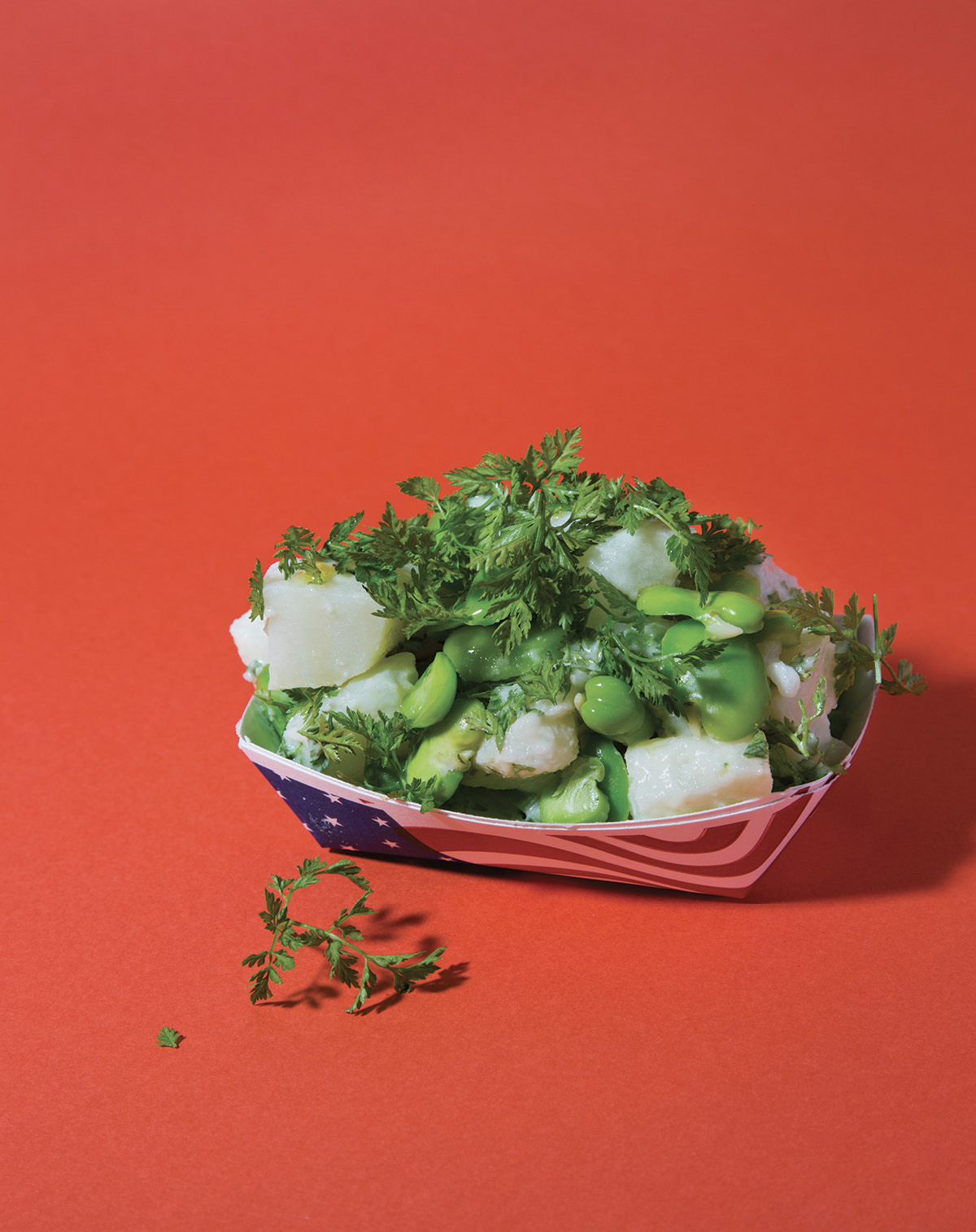
The key here is to use normal commodity potatoes (no market fingerlings, nothing waxy), and the presence of vinegar to miraculously and scientifically keep the chopped russets intact while getting semi-violently boiled. We do a version of this throughout the year, but when you can get your paws on springtime farmers’ market chervil that will make your rented taxi or backseat stink of licorice, then you have really gotten the point of this book.
Serves 6
1 pound russet potatoes, peeled and cut into 1-inch pieces
2 tablespoons plus 1 teaspoon cane sugar
2 tablespoons white wine vinegar
2 tablespoons seasoned rice wine vinegar
1 English cucumber, cut into small dice
2 to 3 cups green peas, fava beans, cut snap peas, and/or string beans, blanched
1½ cups Chickpea Mayo (page 211)
1 cup fresh chervil, finely chopped, plus a little extra for garnish
2 scallions, thinly sliced
Put the potatoes into a large pot. Add 2 quarts cold water, 2 tablespoons salt, 2 tablespoons of the sugar, and the white wine vinegar to the pot and bring to a boil over high heat. Once the liquid is boiling, reduce the heat a little and cook until the potatoes are just tender—they should still hold their shape—about 10 minutes. Drain in a colander and immediately transfer to a baking sheet, spreading the potatoes into a single layer. Sprinkle the hot potatoes with the rice wine vinegar and set aside to cool completely.
Meanwhile, in a large bowl, toss diced cucumber with the remaining 1 teaspoon sugar and a good pinch of salt. Once the potatoes are cool, add to the bowl with the cucumbers. Also add the green vegetables of your choice (note: you can use all of one kind or a variety—frozen peas work nicely here too). Mix in the mayonnaise, chervil, scallions, and 1 teaspoon pepper and stir until the potatoes are fully coated in an herby creamy sauce. Cover the bowl with plastic wrap and let sit in the refrigerator for at least 30 minutes—though a little longer is often better—to allow the flavors to blend together. Remove from the refrigerator 15 minutes before serving—it will taste better. Check seasoning for salt and acid. If needed, add more salt and a splash more rice wine vinegar. Top with chopped chervil and freshly ground pepper.
CORN AND TOMATOES WITH BRUISED BASIL AND OLIVE OIL CROUTONS
Save this one for when you are cranking the AC down to 64, your hair is curling uncontrollably, and everyone is yammering on about the humidity. Deep summer. When the corn is sweeter than the draped sauce on a turnpike Cinnabon, and the tomatoes require little more than responsible salting and a squirt of olive oil. It helps that the fronds of basil at the market at this same time are cunning and laserlike in their perfect basility.
Serves 4
CREAMLESS CREAMED CORN
6 ears of corn, husked, kernels removed from the cob, cobs saved
Grapeseed or extra virgin olive oil
1 medium yellow onion, cut into small dice
Nice olive oil
6 nice ripe tomatoes, red or green
2 tablespoons extra virgin olive oil
3 tablespoons seasoned rice wine vinegar
2 teaspoons Korean chile flakes
1 cup picked fresh basil leaves
½ cup toasted sourdough croutons
To make the creamless creamed corn, bring 2 quarts of water to a boil in a large pot. Add the 6 reserved corncobs and let them boil for 20 to 30 minutes. Remove and discard the cobs but save the liquid—this is corn stock. In a deep skillet over medium-high heat, add a few tablespoons of grapeseed oil. Add the diced onion along with a large pinch of salt and cook, stirring very frequently, until the onions develop a dark brown color and stick to the bottom of the pan a little bit. Add the corn kernels and cook for 1 minute more. Add 3 cups of the corn stock to the pot and reduce the heat to medium-low. Using a spoon, scrape the stuck brown bits off the bottom of the pot. Cook everything until the kernels are just tender, 10 to 15 minutes, then remove from the heat. Using an immersion blender, blend the corn mixture—it should be pretty chunky, like loose polenta. Season with a splash of nice olive oil, salt, and pepper and let cool to room temperature.
To assemble, cut the tomatoes into large chunks that still can be eaten in one bite. Combine the tomatoes with the olive oil, rice wine vinegar, chile flakes, and salt and pepper in a medium bowl. Stir gently to combine. Tear the basil leaves and smear them together to release their oils. Add to the bowl and toss one more time. To serve, put 2 cups creamed corn on the bottom of a serving dish and top with the tomatoes and a little bit of their liquid. Finish with nice olive oil and a few croutons (not too many—let the tomatoes be the star).
ROASTED RED TOMATOES WITH CREAMLESS CREAMED CORN
Serves 4
Any leftover tomatoes or not-so-great tomatoes, cut into large chunks
2 tablespoons extra virgin olive oil
1 to 2 tablespoons raw sugar
2 teaspoons crushed red pepper flakes
2 teaspoons fennel seeds, toasted and crushed, plus more for garnish (optional)
2 garlic cloves, thinly sliced
2 cups Creamless Creamed Corn (page 70)
1 cup picked fresh basil leaves
2 tablespoons red wine vinegar
Grilled bread drizzled with olive oil to serve
Preheat the oven to 300ºF.
Combine the tomatoes, olive oil, sugar, red pepper flakes, fennel seeds, and garlic in a shallow baking dish. Add some salt and be generous with black pepper. Stir to combine and put into the oven. Cook for as long as possible, 1 to 2 hours, until the tomatoes break down some and the tomato liquid concentrates and becomes thicker. To serve, mix the roasted tomatoes and some of their liquid with the corn, tear in the basil leaves, add some red wine vinegar, and season with salt and black pepper. You can add more toasted and slightly ground fennel seeds if you want. Serve with hot grilled/toasted bread drizzled with olive oil. Use your bread to scoop up the tomato-corn gloop.
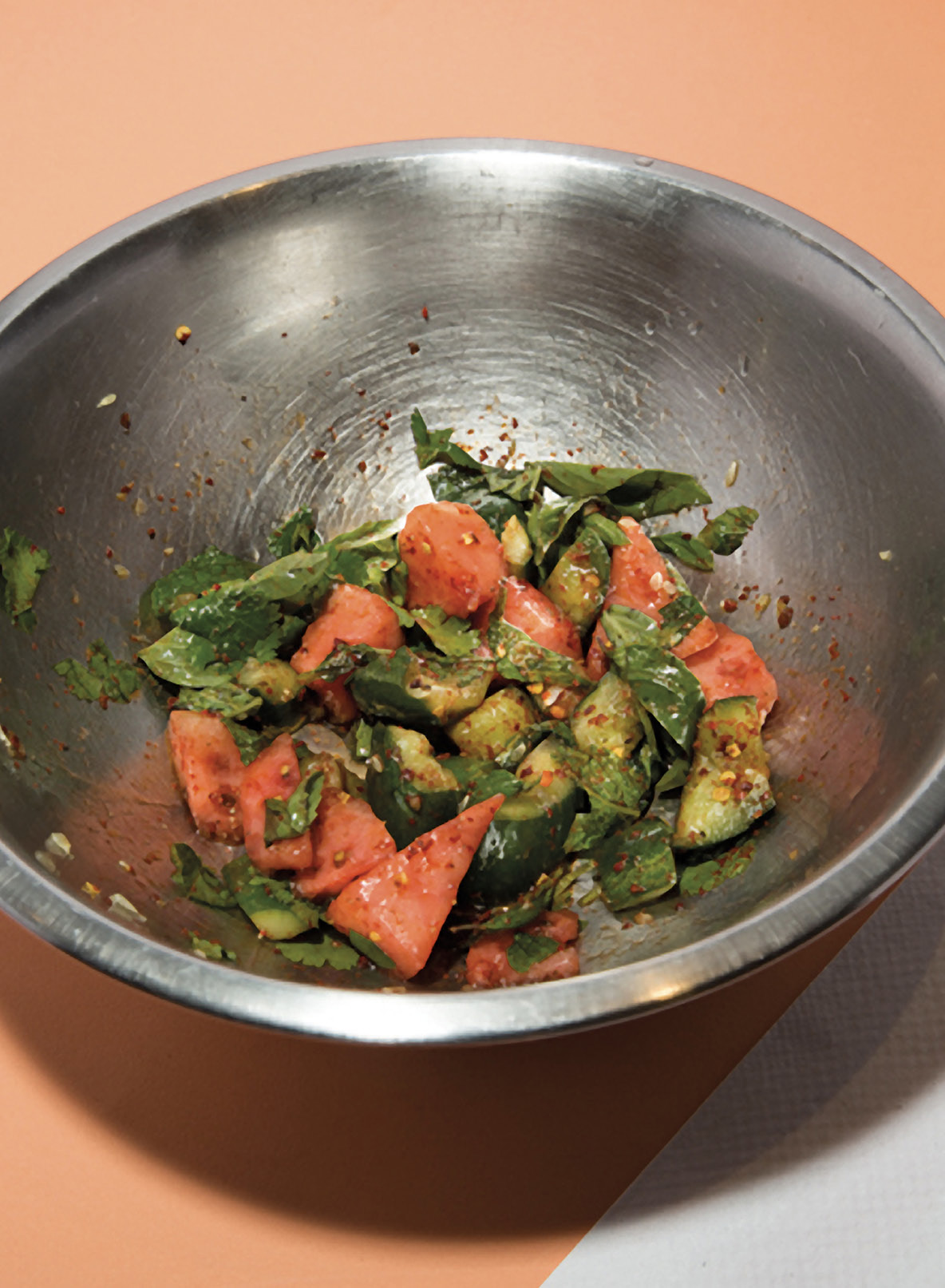
ICE-COLD HERBED MELON AND CUCUMBER SALAD
More summery bluster here. This straddles the line between salad and dessert. There are no alliums, so it could go either way. Keep everything very cold and it will be wholly refreshing and more satisfyingly hydrating than one of those curved aseptic boxes of coconut water or a plastic-bottled, fitness-club-vending-machine sports elixir.
Serves 6
6 cups melon cut into 1½-inch pieces (avoid the seeds)
2 English cucumbers, cut into 1-inch pieces or smashed (see Iced and Smashed Cucumber Salad, page 84)
1 cup fresh Thai basil, roughly chopped
1 cup fresh cilantro, roughly chopped
1 cup fresh mint, roughly chopped
Zest and juice of 4 limes
1 tablespoon Korean chile flakes
1 to 2 teaspoons maple syrup
Before you start, have this in mind: Try to keep everything as cold as possible. This salad is best eaten on a hot day either right out of the refrigerator or held on ice. Combine the melon and cucumber pieces in a large bowl. Add the herbs and gently toss so that all the herbs stick to the melon and cucumber pieces. Add the lime zest, lime juice, chile flakes, and a good amount of salt and mix well but gently. It may need more salt. The optimal flavor of the melon and cucumber relies on being highly salted. Add a pinch of pepper and taste. If necessary to smooth out the acidity of the lime or sweeten the melon, add a teaspoon or two of maple syrup. Refrigerate for at least 30 minutes before serving. Eat ice cold.
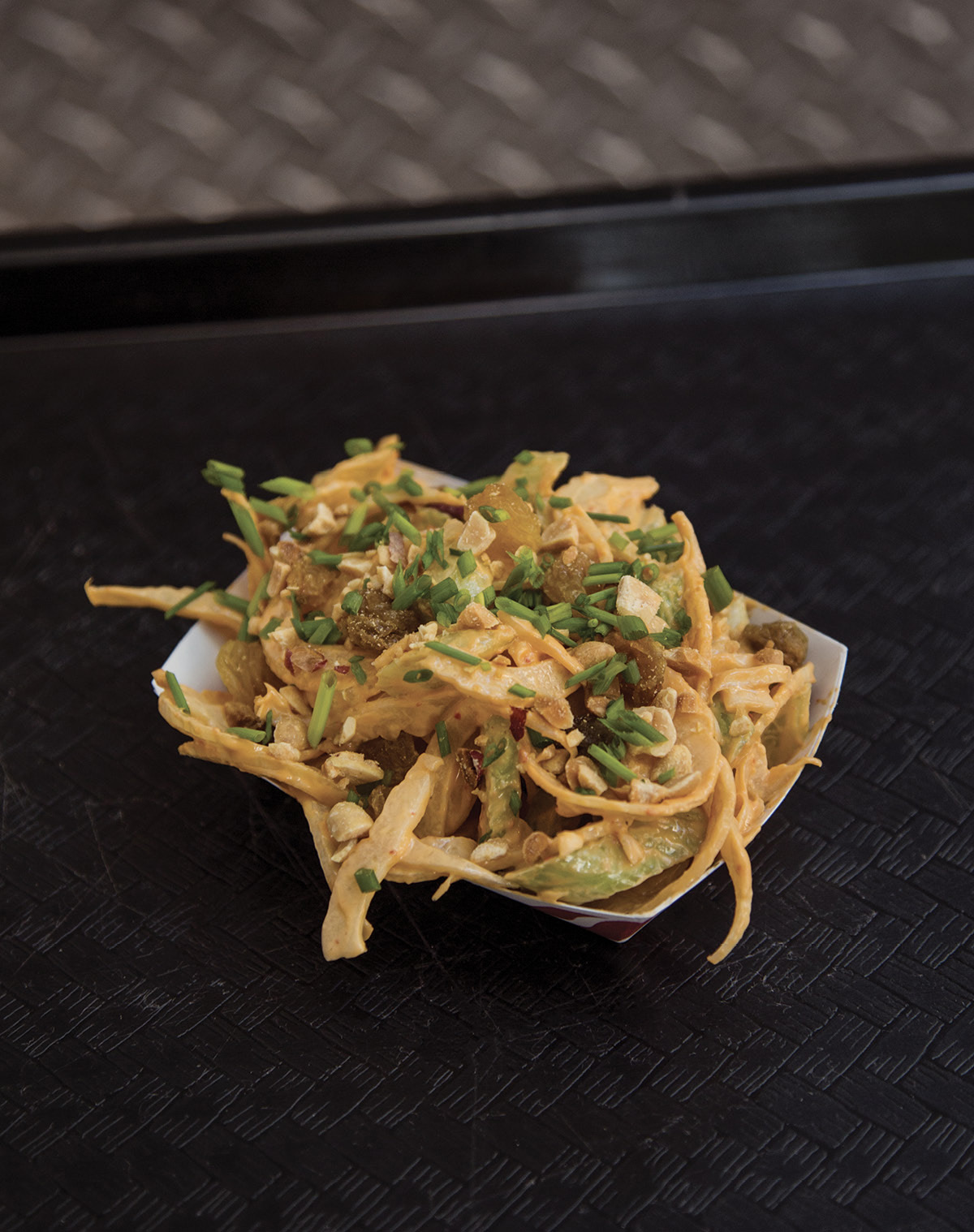
FENNEL AND CELERY SALAD WITH SPICY PEANUT SAUCE
Once when we were listening to an AM talk radio show in the early 90s, Conservative host G. Gordon Liddy claimed on air that the word “crispy” was a fabrication of fast-food establishments like KFC and that “crisp” is the proper word. This salad is very crisp. Almost crispy.
Serves 6
PEANUT SAUCE
One 16-ounce jar creamy peanut butter
1 cup pickled chile peppers (we use pickled Fresnos from the Burnt Broccoli Salad, page 50)
2 tablespoons pickling liquid from the peppers above
2 teaspoons maple syrup
3 fennel bulbs, shaved thinly on a mandoline
8 celery stalks, cut ¼ inch thick on a bias
Juice of 2 lemons
Extra virgin olive oil
1 small bundle fresh chives, cut thinly
½ cup dark raisins
½ cup unsalted roasted
peanuts, chopped
To make the slightly spicy peanut sauce, place the peanut butter, chiles, and pickling liquid in the bowl of a food processor. Process until the chiles are totally chopped up and incorporated into the peanut butter. While the machine is running, stream in water until the sauce is pretty loose—the consistency of salad dressing. The peanut butter will look weird and seem to have separated. Keep adding water little by little and it will come back together and thin out. Add the maple syrup and salt to taste.
In a large mixing bowl, toss together the fennel and celery. Add the lemon juice and a splash of olive oil along with a substantial pinch of salt and black pepper. Stir in the chives and raisins. Drizzle with 1 cup of the peanut sauce right before serving and sprinkle with the chopped peanuts.

We use a lot of cabbage at the restaurant. It takes up a lot of space. Until you cook it, then it takes up no space. It’s in this salad, but you almost don’t notice it. During the summer of 2016 we were committed to conquering the piles of greenmarket okra that we had been weirdly scared of in years prior. This roasting method squelches the unpleasant slimy goo that most people associate with okra. The dressing is thinned-out labne and finds us again reaching into the pantry for our favorite brown rice. Toss the seasoned spicy okra with the dressed rice and you have eerily re-created a wholesome version of Cool Ranch Doritos.
Serves 6
OKRA RUB
1 cup firmly packed dark brown sugar
¾ cup smoked paprika
¼ cup raw sugar
⅓ cup kosher salt
3 tablespoons onion powder
3 tablespoons garlic powder
3 tablespoons chile powder
3 teaspoons freshly ground black pepper
1 to 3 teaspoons cayenne pepper (add as much or as little to taste)
2 teaspoons dry mustard
1 pound okra, cut on the bias into ½-inch-thick slices
About 2 tablespoons extra virgin olive oil
1 head green cabbage, cut into ¼-inch ribbons
1 tablespoon cane sugar
1 large bunch fresh dill, finely chopped, plus dill sprigs for garnish
2 cups cooked brown rice (page 211), cooled
½ cup labne or vegan yogurt
2 tablespoons malt vinegar
1 cup blanched slivered
almonds, toasted
For the okra rub, mix together everything from the rub list (dark brown sugar, smoked paprika, etc.) in a medium bowl. Store in a dry, cool spot for up to 2 months until ready to use.
Preheat the oven to 375ºF. Line two baking sheets with parchment paper.
Put the okra into a large bowl and add a little of the oil—just enough to barely coat. Add ¾ cup of the spice rub and toss the okra thoroughly so that each piece is coated with some rub. Divide the okra between the baking sheets and spread into a single layer. Bake for 15 minutes and check to make sure the edges aren’t browning too fast. If so, just toss the okra with a spatula and return it to the oven. Check every 5 minutes until the okra is a darker golden brown. Remove from the oven and let cool for a bit.
Combine the cut cabbage with the sugar and 2 large pinches of salt in a large bowl. Toss thoroughly and let sit for about 15 minutes, until the cabbage begins to weep and wilt. Drain. Add the chopped dill to the cabbage and mix. Add the rice to the bowl and toss to evenly distribute the cabbage into the rice. In a small bowl, mix the labne with the malt vinegar and a splash of water and mix to make a smooth dressing. Pour over the cabbage and rice and mix to fully incorporate. Add 2 big pinches of black pepper and check the salt content. When you are ready to eat, scoop a little rice into a bowl. Add a small handful of the okra, and add another spoonful of rice on top of the okra. Top with the almonds and some picked fresh dill sprigs.
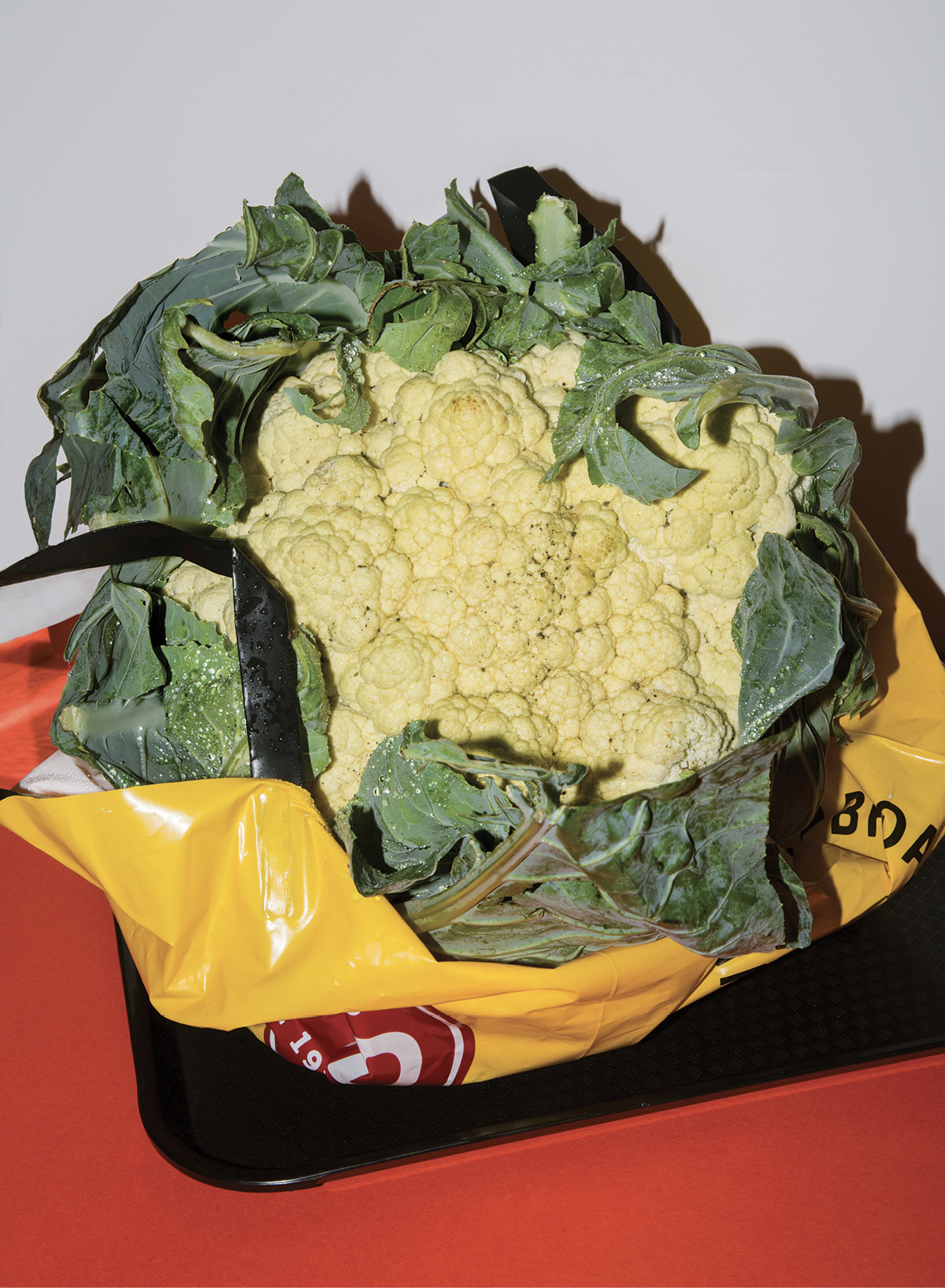
ROASTED CAULIFLOWER WITH TAMARIND, SHISO, AND PEANUTS
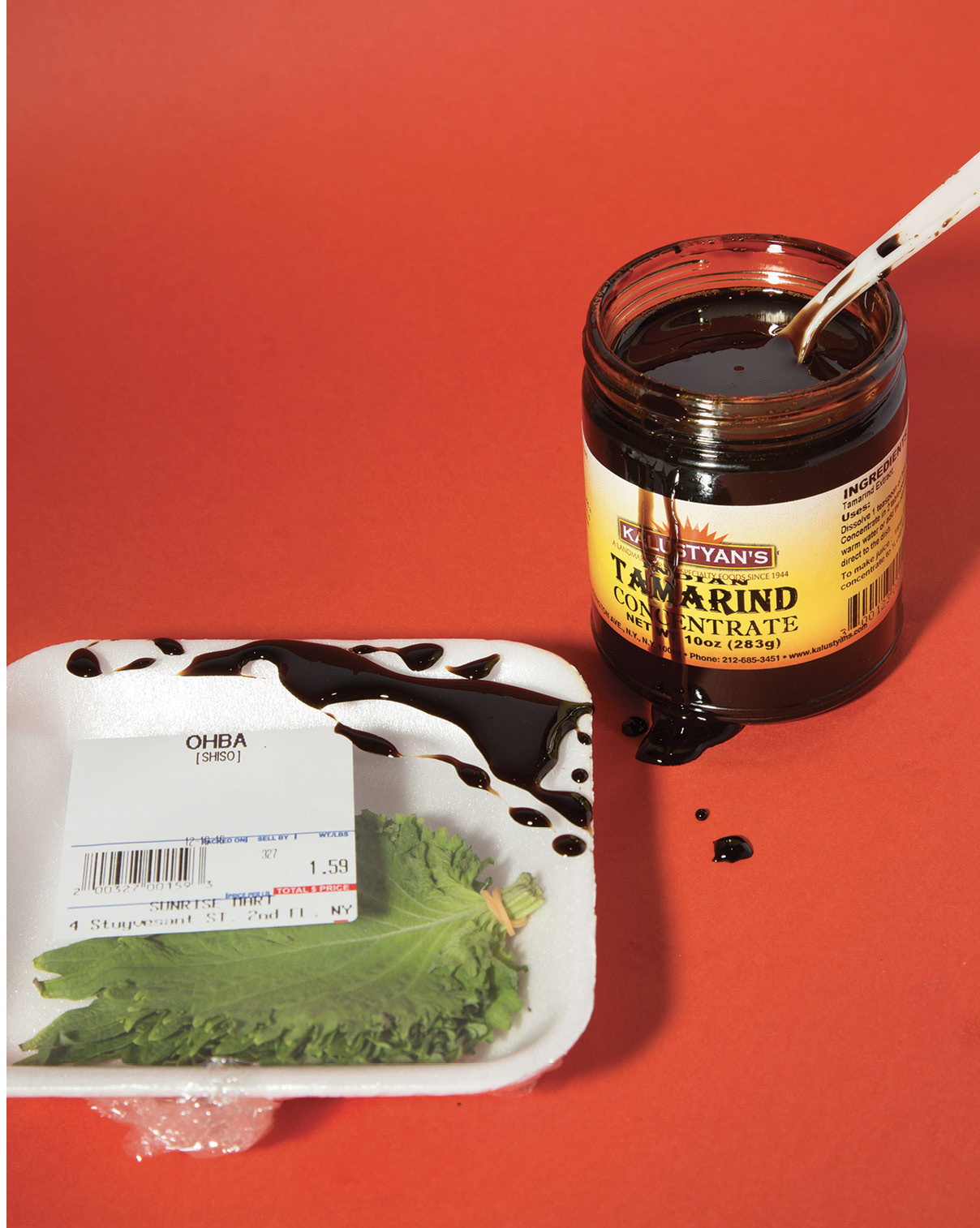
This patty spice blend is good to have on hand. It was our attempt to reverse engineer the seasoning of the ubiquitous Jamaican beef patties that all the finest street-corner pizza parlors of the East Village keep at room temperature in glass cases next to the pre-cut pies. The tamarind mixture sweetens and is an all-around great dipping sauce (not bad on a dollar slice, actually). Shiso may not be traditional to a beef patty, but it adds an herbal electricity that makes this salad very bright and craveable.
Serves 6
PATTY SPICE BLEND
4 tablespoons cumin seeds
4 tablespoons mustard seeds
2 tablespoons aniseeds
2 star anise
6 tablespoons coriander seeds
2 teaspoons allspice
3 teaspoons fenugreek
TAMARIND SAUCE
1 cup tamarind pulp concentrate
½ cup maple syrup
1 tablespoon tamari
¼ cup extra virgin olive oil
1 large head cauliflower, cut into medium florets
1 cup shiso leaves, roughly chopped (fresh mint works here as well)
½ cup unsalted roasted peanuts, chopped
For the patty spice blend, toast everything from the spice blend list in a large dry skillet until fragrant. Grind in a clean coffee grinder. Transfer to a small bowl. Store in a cool, dry place for up to 2 months until ready to use.
For the tamarind sauce, mix together the tamarind pulp, maple syrup, and tamari in a small bowl. Season with salt if needed.
Preheat the oven to 450ºF. Lightly grease two baking sheets.
Mix together the olive oil and 6 tablespoons of the spice blend in the bottom of a large bowl. Add the cauliflower florets to the bowl and toss until the florets are fully coated in oil and spices. Divide the florets between the baking sheets and spread into a single layer. Sprinkle generously with salt. Put the sheets in the oven and bake for 20 minutes, then check. The florets should be brown and crispy at the edges and tender in texture. Scatter the cauliflower on a serving dish. Drizzle with 1 cup of the tamarind sauce, and scatter the shiso leaves and chopped peanuts judiciously over the cauliflower. Eat at room temperature.
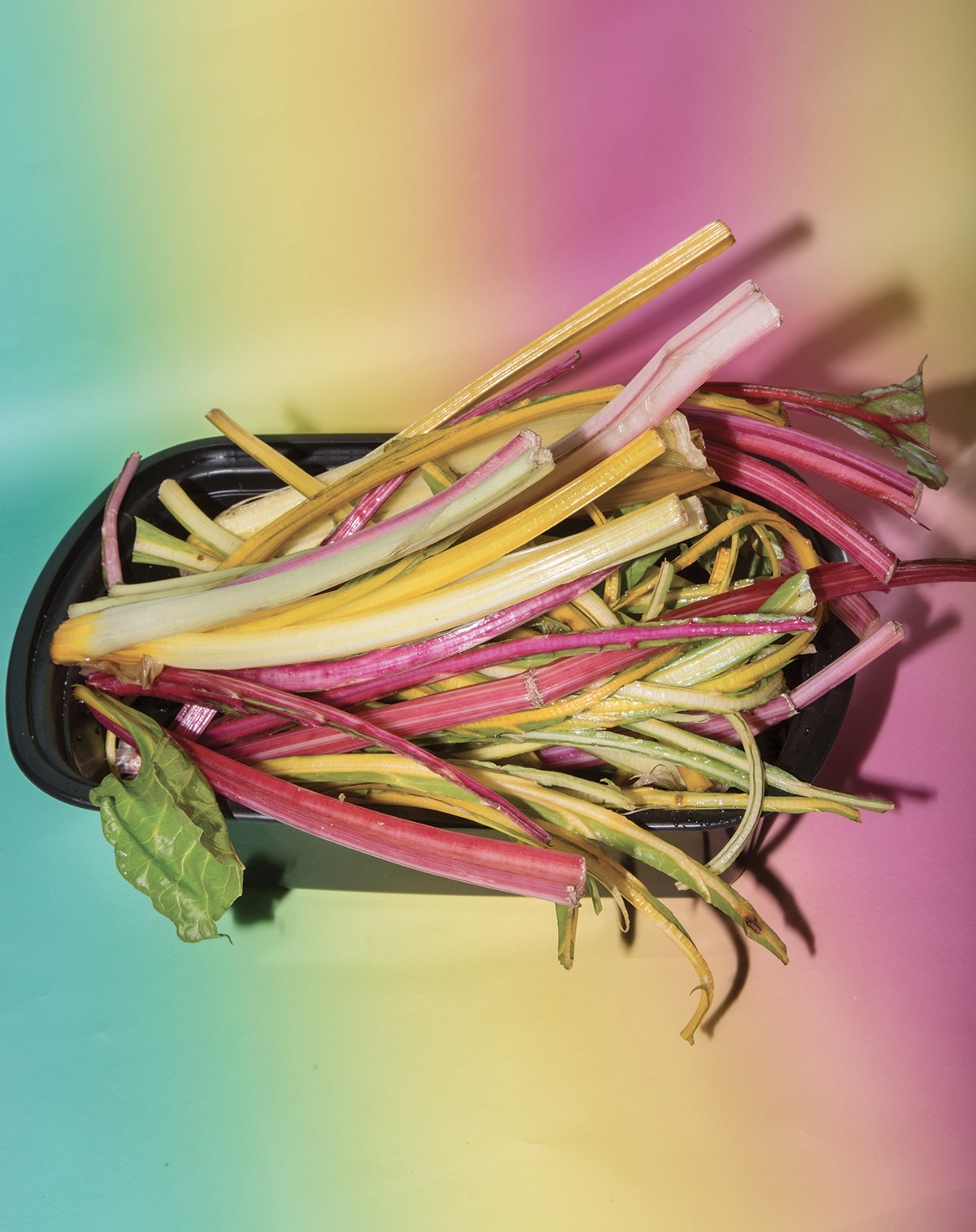
While usually braised or hammered to within an inch of its life, Swiss chard is also very tasty raw when it is young and fresh at the summer markets. Choose tender leaves and reserve the stems for their supporting-player crunch. The vinaigrette has a base of roasted garlic that will make your kitchen smell incredible and remind you just how good slow-cooked garlic is. When blackberries or plums are potent, we recommend folding in a few to the finished dish for their jammy bursts. The griddled halloumi cheese makes the whole thing hearty and satisfying. Roasted garlic? Almost raspberry vinaigrette? Warm cheese? What is this? 1987? Yeah, maybe.
Serves 6
ROASTED GARLIC VINAIGRETTE
4 garlic cloves, unpeeled
½ cup golden balsamic vinegar
2 tablespoons water
1½ cups extra virgin olive oil
2 teaspoons kosher salt
1 bunch Swiss chard, leaves separated from the stems, stems saved
Grapeseed oil
One 8-ounce block halloumi cheese, cut into ½-inch cubes (or Cheesy Brined Tofu, page 207, for a vegan alternative)
½ cup Pickled Onions (page 204)
1 cup really nice fruit (blackberries or sliced plums work well)
For the roasted garlic vinaigrette, roast the garlic cloves, still in their peels, wrapped in aluminum foil in a 350ºF oven until totally tender and golden in color, about an hour. Squeeze the garlic out of their peels before using. In a blender, blend the roasted garlic with the golden balsamic vinegar and water until the garlic is totally dissolved into the vinegar. With the blender running on a low speed, slowly stream in the olive oil and add the salt.
Tear the chard leaves into easily eaten–size pieces. Cut the stems into ¼-inch pieces and store in a small bowl with very cold water. In a medium skillet, heat a splash of grapeseed oil until it is very hot. Sear the halloumi until browned and crispy on at least two sides. Transfer to a small bowl and set aside.
In a large bowl, toss the chard leaves, cut stems (drain off the cold water), and pickled onions with ¼ cup of the garlic vinaigrette until lightly coated—responsibly dressed. Season with salt and pepper. Mound the dressed leaves onto a large plate. Tuck pieces of fruit and cheese into the mound of salad, making sure some are visible. Eat quickly while the halloumi is still warm.
ICED AND SMASHED CUCUMBER SALAD
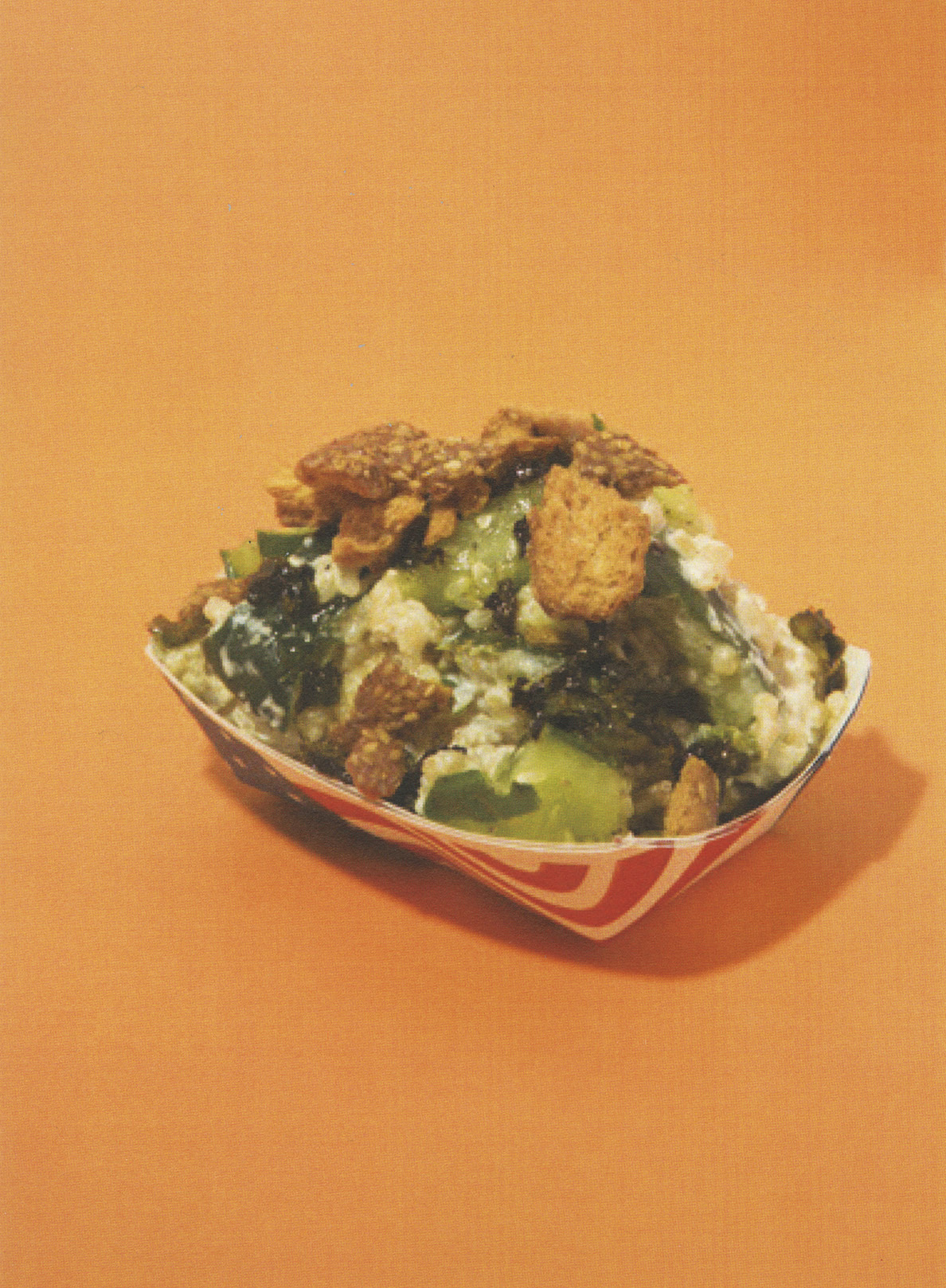
One of our first really special specials. We wait until there are oddly shaped, twisted, and multicolored local cucumbers at the summer greenmarket before doing this one. The jalapeño-honey makes the whole thing unexpectedly spicy, and the smashed cucumbers bring a nice texturally swollen, watery chomp. If you close your eyes it almost tastes like chicken salad.
Serves 6
2 pounds English or Persian cucumbers
Pinch of sugar
½ cup labne or vegan yogurt
Zest and juice of 2 limes
1 tablespoon seasoned rice wine vinegar
2 tablespoons extra virgin olive oil, plus more for drizzling
½ teaspoon freshly ground black pepper
1 jalapeño chile, minced
4 tablespoons honey or maple syrup (for the vegan version)
1 cup crushed sesame breadsticks
2 cups cooked brown rice (page 211), cooled
4 scallions, minced
Rinse the cucumbers and pat dry. Cut crosswise into pieces about 4 inches long. Place the cucumbers in a plastic bag and seal. Use the end of a rolling pin to smash the cucumbers. They will begin to break into pieces. Do not obliterate. Break or slice diagonally into bite-size pieces if the pieces are too large. Place the cucumber pieces in a strainer and toss with a big pinch of salt and a big pinch of sugar. Place a plastic bag filled with ice on top of the cucumbers to serve as a weight and place the strainer over a bowl. Let drain for 15 to 30 minutes on the counter, or in the refrigerator until ready to serve, up to 4 hours.
Mix the labne, lime zest, lime juice, rice wine vinegar, olive oil, ½ teaspoon salt, and the pepper in a bowl. This mixture should taste fiercely acidic and quite salty; add salt and vinegar as needed. Keep refrigerated.
Combine the minced jalapeño and honey in a small bowl and stir well until smooth.
Toast the breadstick pieces in a toaster oven or skillet. Drizzle with olive oil and stir occasionally, until golden and crunchy.
When ready to serve, shake the cucumbers well to drain off any remaining liquid and transfer to a bowl. Add the brown rice. Drizzle lightly with olive oil and toss. Add the scallions and half of the labne dressing and toss gently. Keep adding dressing until the cucumbers and rice are well coated but not drowned. Serve immediately. For each serving, scoop a large spoonful of salad into a bowl, drizzle with the spicy honey, and sprinkle with a handful of sesame croutons.
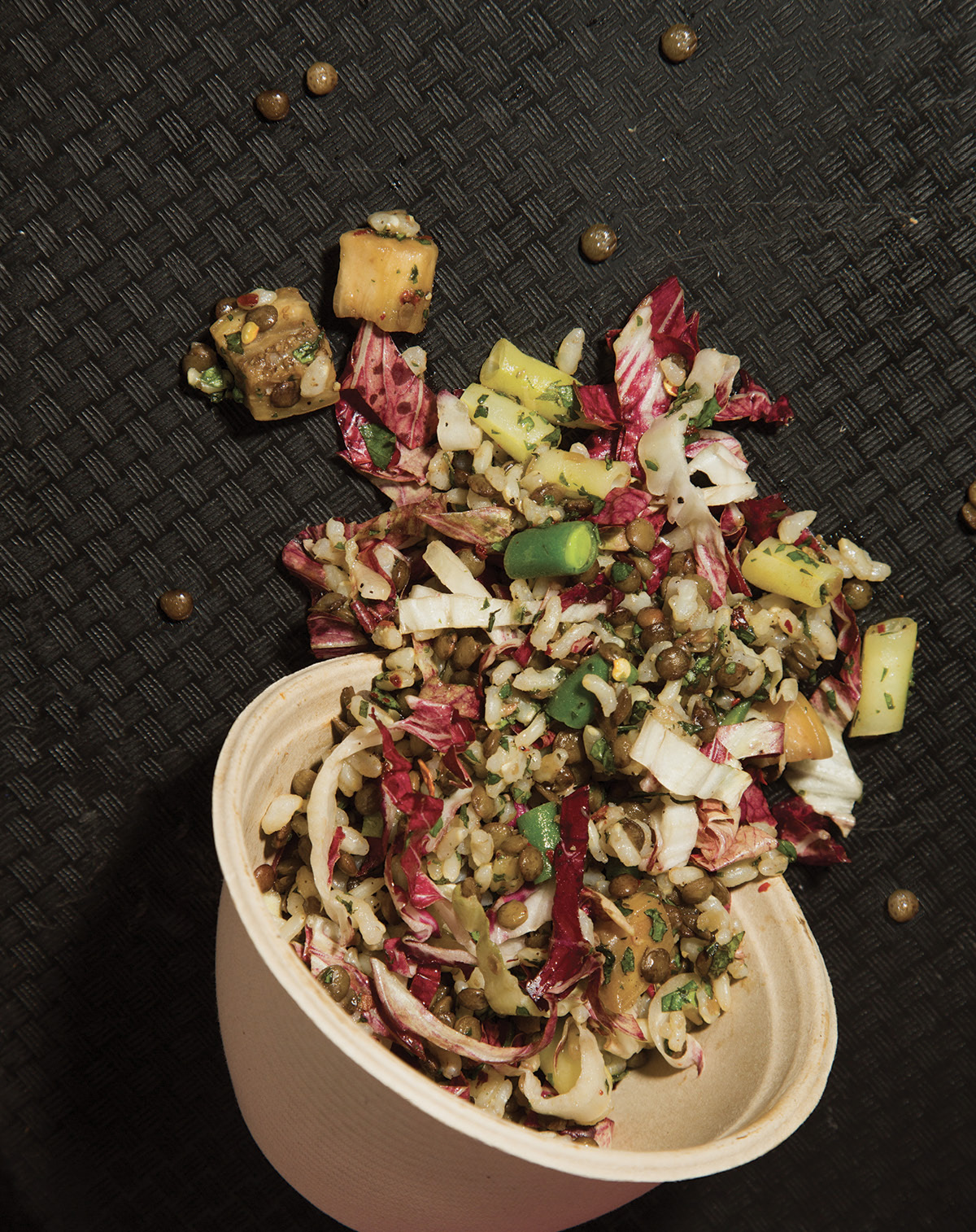
Not the greatest name, we know. The quick-brined eggplant is both a revelation and kind of a custardy treat, and helps the lentils feel slightly less underappreciated. Go crazy with the herbs, and the radicchio is in there for a bitter adult romp. Don’t bother with fresh peas, even if they are in season; their presence here is muted, so the frozen bag is just fine.
Serves 6
2 cups lentils du Puy, rinsed and picked over
1 star anise
4 tablespoons extra virgin olive oil
2 tablespoons red wine vinegar
1 medium eggplant, cut into medium dice
1 cup frozen green peas, defrosted
1 to 2 cups chopped fresh herbs (equal parts fresh mint, cilantro, and Thai basil)
2 heads radicchio, thinly sliced
EGGPLANT BRINE
3 cups white wine vinegar
½ cup water
¼ cup sugar
Put the lentils, star anise, and 1 teaspoon salt in a large saucepan and cover with water by 3 inches. Bring to a rolling boil, then reduce to a simmer and cook until the lentils are just tender, about 25 minutes. Drain well and put into a bowl. While the lentils are still hot, add 2 tablespoons of the olive oil, the red wine vinegar, and salt and pepper. Set aside to cool to room temperature.
While the lentils are cooking, preheat the oven to 375ºF.
Bring brine ingredients to a boil in a small saucepot, season with salt and pepper. Add the eggplant pieces and simmer for a few minutes, just until they can be pierced with a knife. They will retain their form. Immediately drain the eggplant and lay out on a baking sheet to cool as quickly as possible.
In a medium bowl, combine the lentils with the cooked eggplant, green peas, herbs, and radicchio. Check the seasoning. If necessary, add more red wine vinegar, salt, and pepper. Serve at room temperature.
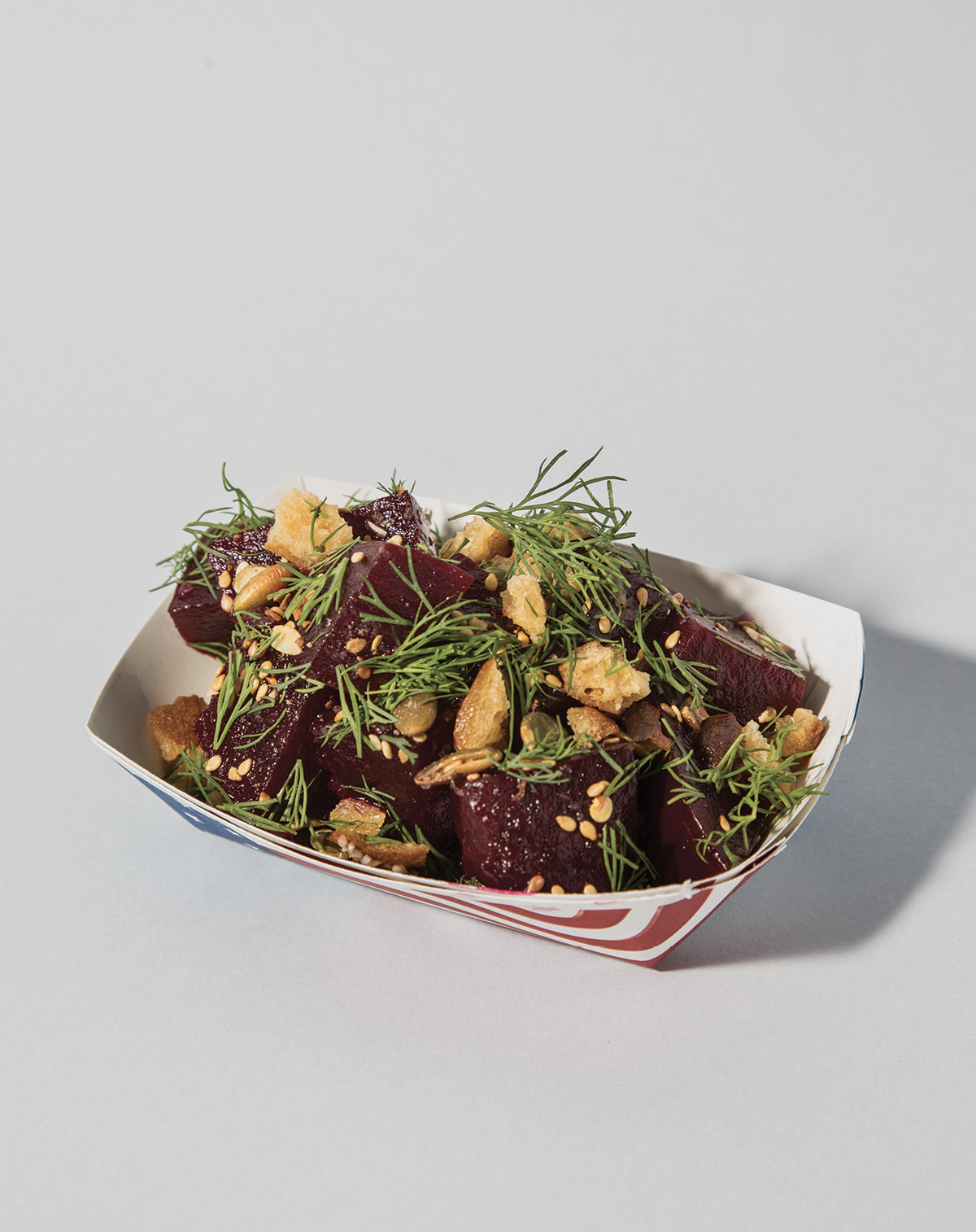
SWEET-AND-SOUR RED BEETS WITH CREAM CHEESE AND FRIED PRETZELS
We are blessed with amazing regulars at Superiority Burger. Some folks come almost every day and get the same thing. Some always want to see what new stuff we have lurking. Either way, we love them all dearly. They are our life’s blood. Jim, one of the “What’s new and cool?” regulars, got two orders of these one night when we got really enthusiastic and talked up this salad as a middle finger to the snoresville beets and goat cheese combo that occupies many modern menus—even going so far as to say that the seed sprinkle was inspired by our pet bird’s food, and that the fried pretzels are the platonic version of pretzels. The next day we were like, “Hey, Jim! How were the beets?” And he responded deadpan and dead serious, “Too much beets.” So, um, recommended if you like beets.
Serves 6
BEET SPRINKLE
½ teaspoon pretzel salt or coarse sea salt
1 teaspoon freshly ground black pepper
1 tablespoon crushed red pepper flakes
2 tablespoons turbinado sugar
½ cup pumpkin seeds, toasted and crushed a little
½ cup sesame seeds, toasted
1 pound red beets
2 cups red wine vinegar
½ to 1 cup maple syrup
1 cup pretzels, crushed into irregular pieces
¼ cup extra virgin olive oil
1 cup cream cheese or vegan cream cheese, softened slightly
½ jalapeño chile, minced
Fresh dill sprigs
To make the beet sprinkle, mix together everything from the sprinkle list and store in a sealed container for up to 2 months until ready to use.
Preheat the oven to 350ºF.
Coat the beets with a little bit of grapeseed oil. Wrap the beets individually or in groups (depending on their size) in aluminum foil. Place the wrapped beets on a baking sheet and cook until a fork can pierce the flesh easily with no resistance, about 1 hour for medium beets. Let the beets cool for a short period. While the beets are cooling, mix together the red wine vinegar and maple syrup and season with salt—should be quite sour with the syrup just to cut the vinegary-ness. As soon as the beets can be handled, remove the aluminum foil and rub the skins off using a clean kitchen towel or your fingers. Cut into medium chunks and put into the bowl. Pour the vinegar mixture over the hot beets and let sit for at least 1 hour. Once cool, store covered in the vinegar liquid in the refrigerator for up to 3 days until ready to use.
Combine the pretzels and olive oil in a small saucepan over medium heat. Stirring frequently, fry the pretzels until they are a rich golden brown. Use a slotted spoon to remove them from the oil and drain on a plate lined with paper towels. In a small bowl, mix together the cream cheese and jalapeño and season with salt and black pepper. For each serving, scoop a little of the jalapeño cream cheese into the bottom of a bowl. Spoon a portion of the marinated beets on top of the cream cheese, being careful not to add too much of the beet pickling liquid. Sprinkle with some of the beet sprinkle (use about ½ cup total) and crushed fried pretzels. Finish with some fresh dill.
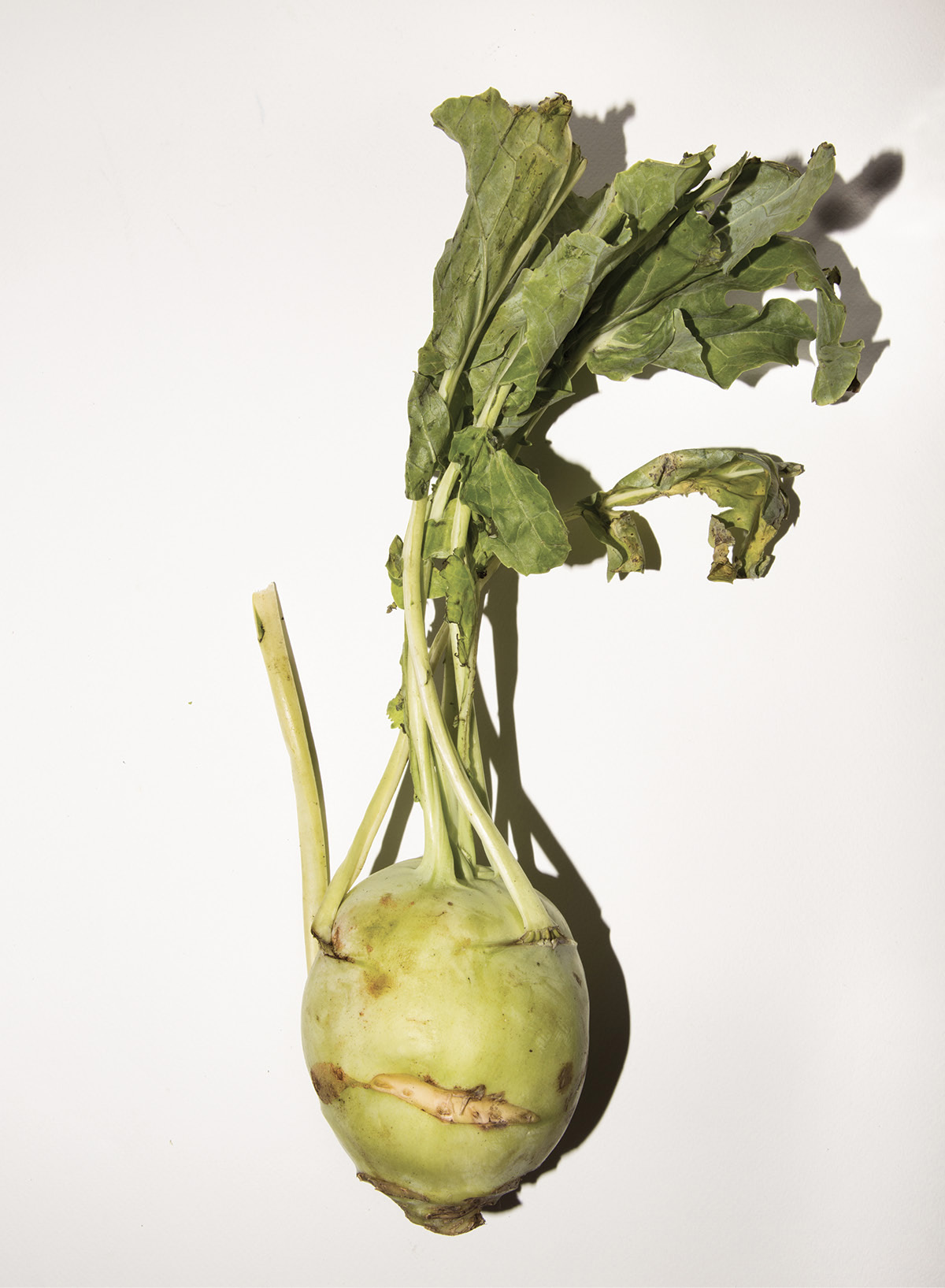
Plastic Japanese mandolines are a godsend. They also can be a philosophical dilemma. Sure, they slice vegetables rapidly, and staring down at a bowl full of perfect strings of kohlrabi will get the alpha tendencies in your cooking personality fully aroused and chest thumping. Just promise us to be careful. Don’t let your mind wander off while the shredding attachment is clipped into the holster. Stay focused, and you will be rewarded with a bright salad that is sinus clearing, gently sweet, and virtuously tasty.
Serves 6
2 large kohlrabi, peeled, stems saved, shredded thinly on a mandoline (toss with lemon juice if not using immediately)
1 cup cider vinegar
1 tablespoon mustard seeds
2 tablespoons cane sugar
2 teaspoons kosher salt
1 cup Chickpea Mayo (page 211)
1 tablespoon fresh lemon juice
1 teaspoon maple syrup
1 tablespoon Dijon mustard
1 teaspoon freshly ground black pepper
2 sour green apples, sliced ⅛ inch thick either with a mandoline or by hand
½ cup fresh dill, chopped
1 cup walnuts, darkly toasted and crushed
Cut the kohlrabi stems into ¼-inch pieces and place in a small bowl. In a small saucepan, combine the cider vinegar, mustard seeds, sugar, and salt and bring to a boil over high heat. Once it is boiling, pour over the cut stems and let sit for at least 30 minutes.
In another small bowl, mix together the mayo, lemon juice, maple syrup, mustard, and pepper to make the dressing for the slaw. The flavor should be a little acidic, a little sweet with an underlying mustard flavor.
Place the shredded kohlrabi in a large bowl and add a few spoonfuls of the pickled stems—don’t worry about the mustard seeds; they add a nice texture and flavor to the salad. Add the dressing, the sliced apples, and the chopped dill and mix well to coat and cover everything. Check to make sure there is enough salt, pepper, and lemon acidity—if not, adjust. Top with the crushed walnuts right before serving.
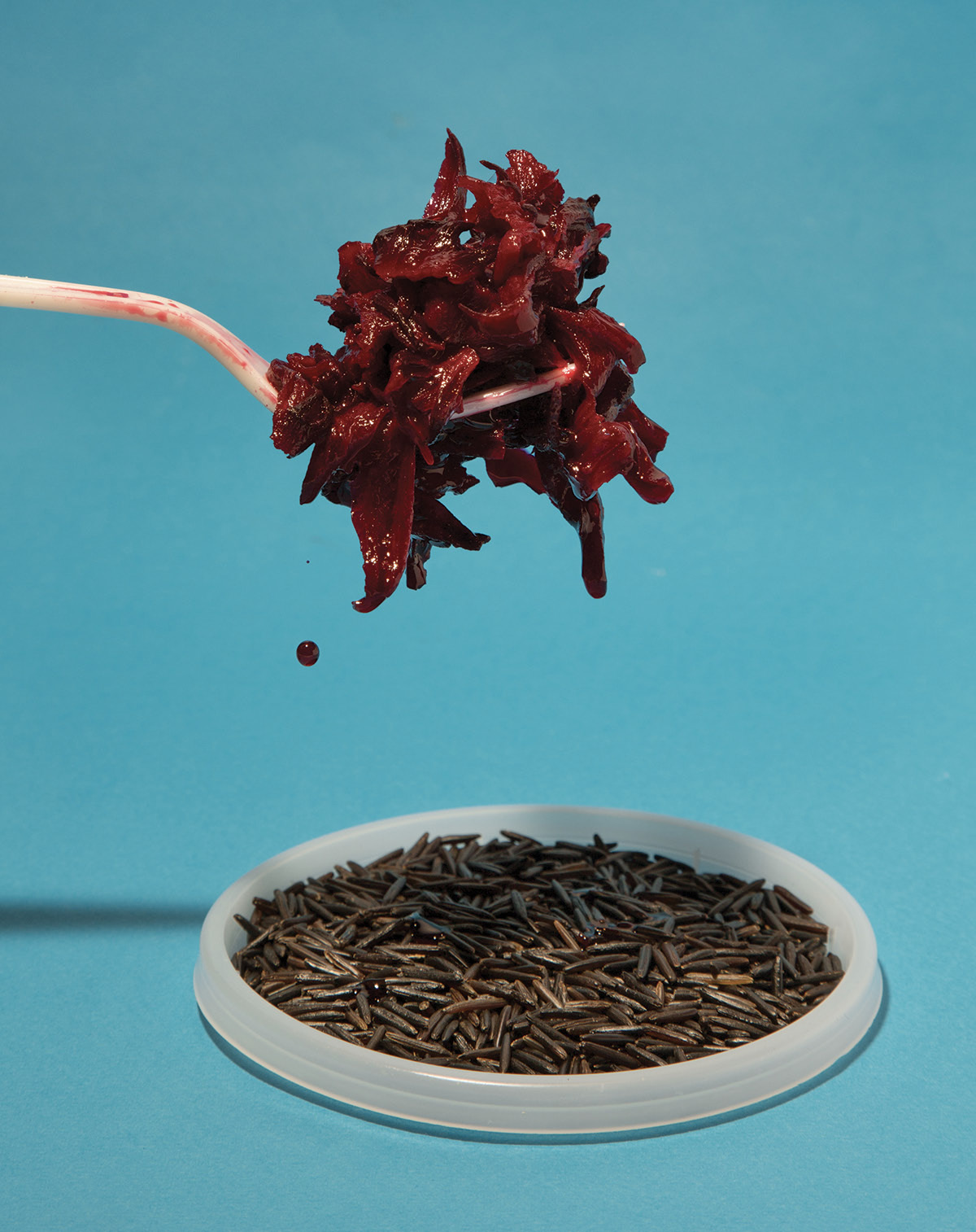
WILD RICE SALAD WITH CANDIED HIBISCUS
Wild rice gets a bad rap in the rice community. Probably because it ain’t rice. It cooks weird, it looks weird, and species wise, it’s a grass. It is often combined with real rice just to keep everyone from completely freaking out. Bloated reconstituted dried hibiscus is the icing on the cake here. There are also some sneaky roasted sweet potato chunks present, but just ducking down and staying out of the way.
Serves 6
2 teaspoons finely chopped fresh rosemary
Zest of 1 lemon
1 teaspoon fresh ginger, grated on the Microplane
Juice of 2 lemons
1 tablespoon maple syrup
½ cup extra virgin olive oil
2 sweet potatoes, peeled and cut into 1-inch cubes
Extra virgin olive oil
2 tablespoons dark brown sugar
2 teaspoons Korean chile flakes
1 cup wild rice, rinsed
2 cups cooked brown rice (page 211)
Squeeze of lemon (optional)
4 scallions, thinly sliced
1 cup dried hibiscus soaked overnight in 1 cup simple syrup
Mix together rosemary, lemon zest, ginger, lemon juice, maple syrup, and olive oil to make the dressing. Season with salt.
Preheat the oven to 375ºF.
Toss the sweet potato cubes with a little olive oil, the dark brown sugar, chile flakes, and salt and pepper. Spread into a single layer on a baking sheet. Cook until browned and tender, 25 minutes. Remove from the oven and set aside.
Cook the wild rice in 3 cups of salted water until tender, about 40 minutes. Drain off any excess water and transfer to a large bowl. Mix the brown rice into the wild rice. Add the dressing and let sit for about 10 minutes to allow the rice to absorb the dressing. Check the seasoning for salt and pepper. If it needs any more acid, add a squeeze of lemon. Stir in the cooked sweet potato and scallions, and top with the candied hibiscus.
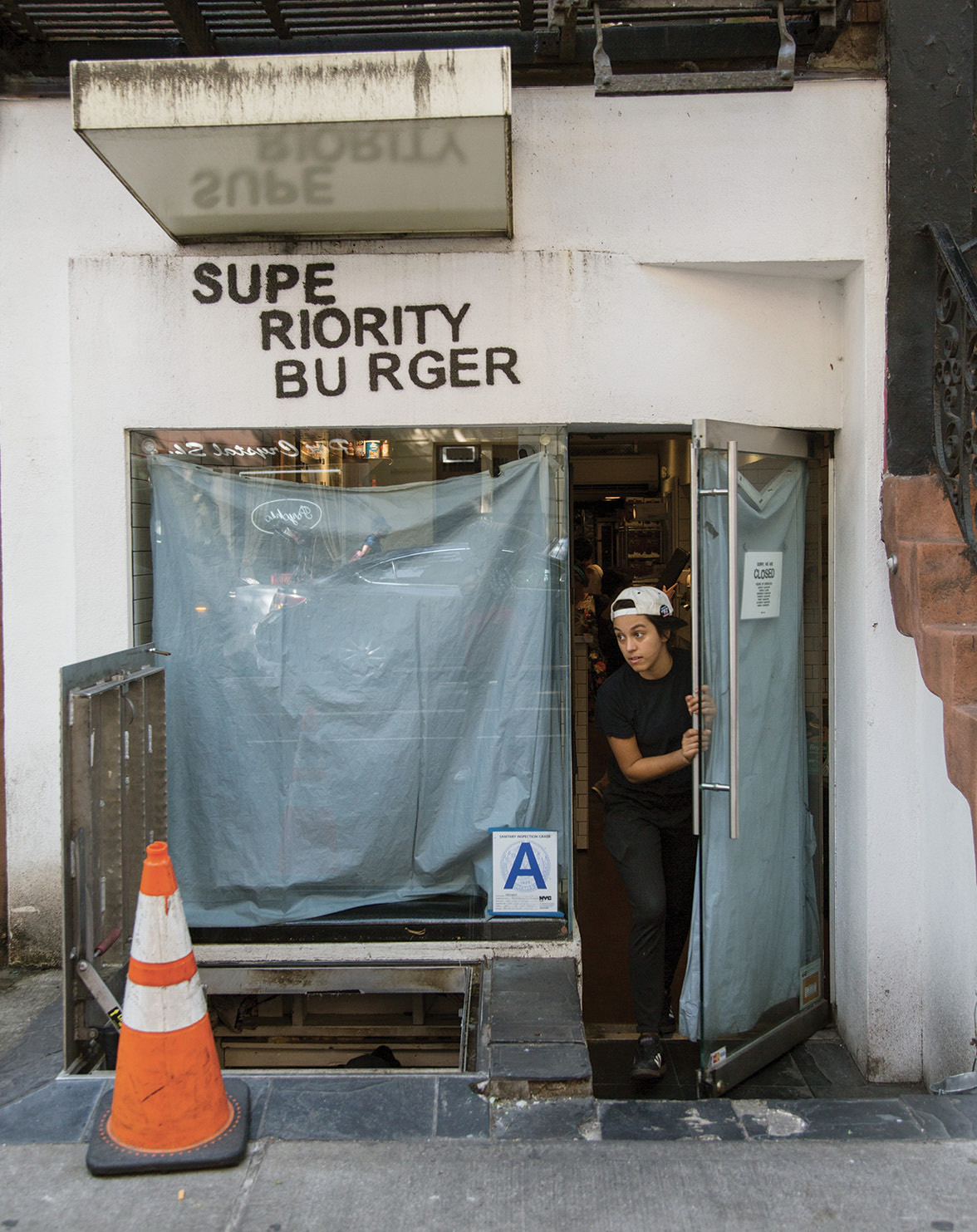
One of our first proclamations when SB opened up was that we would never cook with Brussels sprouts. Between the chances of screwing up the spelling (on the specials board, on in-house prep lists) and the wheat-pasted ubiquity of the mini brassica, we were dead set against ever using them. Then Charlie and Lana, two of our favorite farmers from upstate, arrived with some late-summer Brussels still on the stalk and still sprouting a glorious head of leaves. We fell hard for them. Despite the nearly two-and-a-half-foot trees, the yield ended up being about half a sheet pan of cooked veg. So we ran this special for only a day, and even though people say not using Brussels sprouts is crazy, it seems pretty all right by us.
Serves 6
Extra virgin olive oil
1 pound Brussels sprouts, brown ends trimmed, cut in half
½ teaspoon celery seeds
1 cup Roasted Red Tomatoes (page 71)
1 tablespoon smoked paprika
1 tablespoon sweet paprika
2 tablespoons dark brown sugar
¼ cup red wine vinegar
2 teaspoons kosher salt
1 teaspoon freshly ground black pepper
¼ cup extra virgin olive oil
2 cups cooked brown rice (page 211), warm
1 cup Hammered Mushrooms (page 207), finely chopped
½ cup dates, pitted and torn into pieces
½ cup walnuts, toasted and roughly chopped
1 cup fresh flat-leaf parsley, roughly chopped
2 cups shredded green cabbage
Juice of 1 lemon
Preheat the oven to 425ºF. Lightly grease a baking sheet.
Toss the Brussels sprouts with a few teaspoons of olive oil, the celery seeds, and salt in a medium bowl. Transfer to the baking sheet and roast until crisp on the outside and tender on the inside, about 30 minutes. Remove from the oven and set aside until ready to use.
While the sprouts are in the oven, make the dressing. Combine the roasted tomatoes, smoked paprika, sweet paprika, dark brown sugar, red wine vinegar, salt, and pepper in the bowl of a food processor. Run until the roasted tomatoes are broken down and a cohesive sauce forms. While the machine is running, slowly stream in the olive oil.
To assemble the salad, place the brown rice in a large bowl. Add the Brussels sprouts and chopped mushrooms and toss to combine. Add a few spoonfuls of the dressing and stir thoroughly—you do not want to overdress the rice and make it soggy. If the salad needs more dressing, add cautiously. Gently stir in the dates and walnuts. In a separate bowl, mix the green cabbage with the parsley and lemon juice. Add a pinch of salt and pepper. Mound the cabbage and parsley salad on top of the rice right before serving.
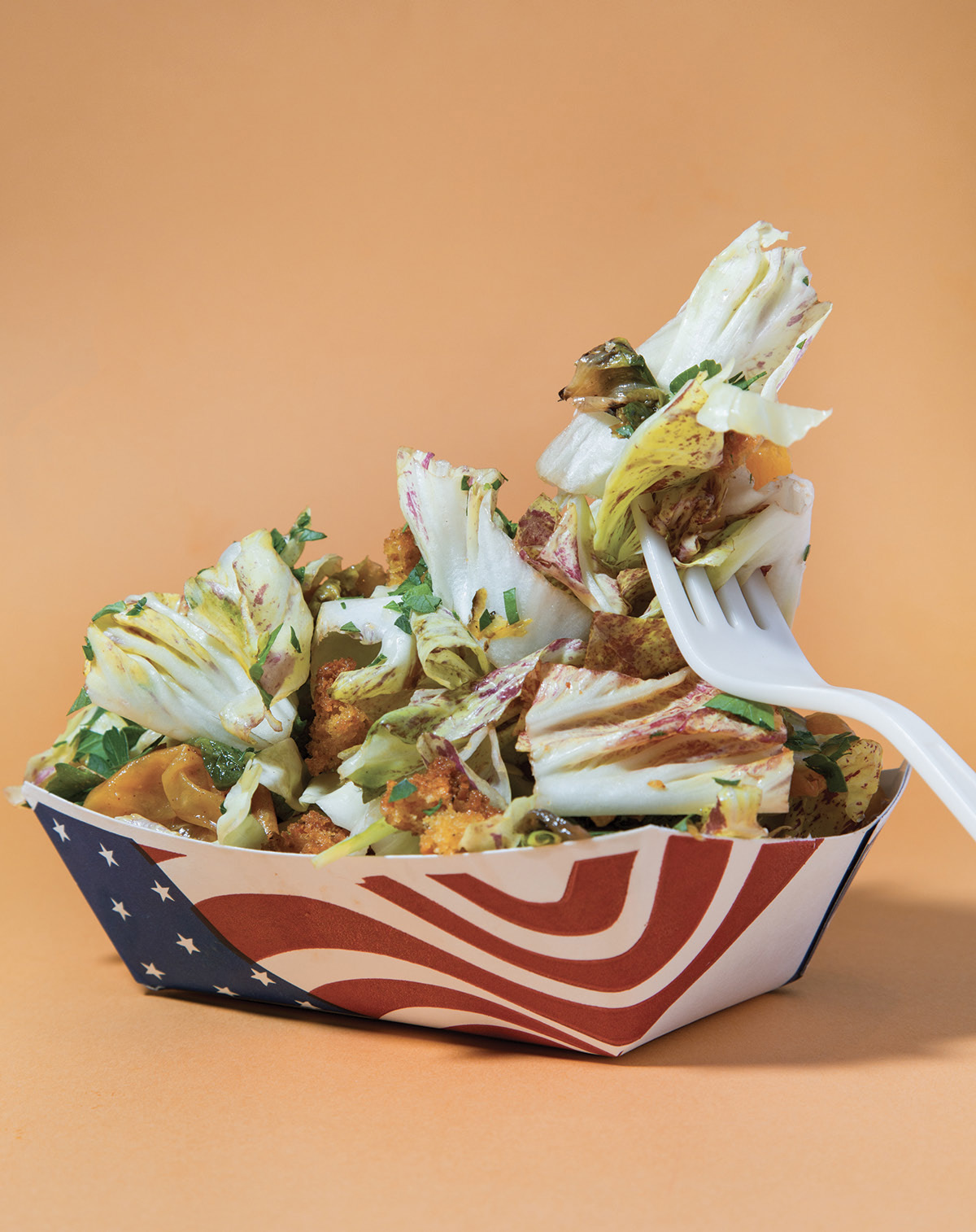
HALF-WILTED ESCAROLE WITH CORN BREAD AND ROASTED APRICOTS
Panzanella, you charlatan. C’mon. Too easy. Totally rote. How about we start this exchange in late spring prior to the sticky, seedy summer tomatoes that just flaunt their effortless beauty? The greens are slightly wilted and bitter here, and the apricots are fresh off the tree, but desperately in need of a clumsy warmth to unlock their true character. The corn bread just completely falls apart, clinging granularly to everything.
Serves 6
½ recipe Corn Bread (page 211) made with chile flakes and black pepper
1 large head escarole, cut into bite-size pieces
3 garlic cloves, sliced paper thin with a mandoline
¼ cup extra virgin olive oil
2 tablespoons red wine vinegar
4 very ripe apricots, cut into 1-inch pieces and tossed with a little sugar and lemon juice
½ cup fresh flat-leaf parsley, roughly chopped
Preheat the oven to 325ºF.
Crumble the corn bread into small croutons and spread out onto a baking sheet. Toast in the oven until they brown just slightly and are lightly dried on the exterior, about 15 minutes. Let cool before using.
Separate the escarole into two groups: Place about three-quarters of the escarole in a large bowl and the other quarter in a medium bowl. In a small skillet, combine the sliced garlic and olive oil and heat over medium-low heat. Don’t walk away from this for too long as you don’t want the garlic to burn. Swirl the pan a little and once all the garlic has just turned golden brown, remove the pan from the heat and pour the hot oil over the smaller bowl of escarole. Let the escarole wilt from the heat of the garlic oil and cool down. Add the wilted escarole, along with the oil and garlic pieces, to the larger bowl of raw escarole. Toss to mix the two. Toss the leaves with the red wine vinegar and season with salt and pepper. Add the corn bread pieces and apricots and give it one last gentle mix. Serve with chopped parsley scattered over the top. Note: If the fruit is not totally ripe—not as juicy, sweet, and tart as it could be—it can be roasted in a 300ºF oven to concentrate the flavor and release more juices. Just let the roasted fruit cool before adding it to the salad.
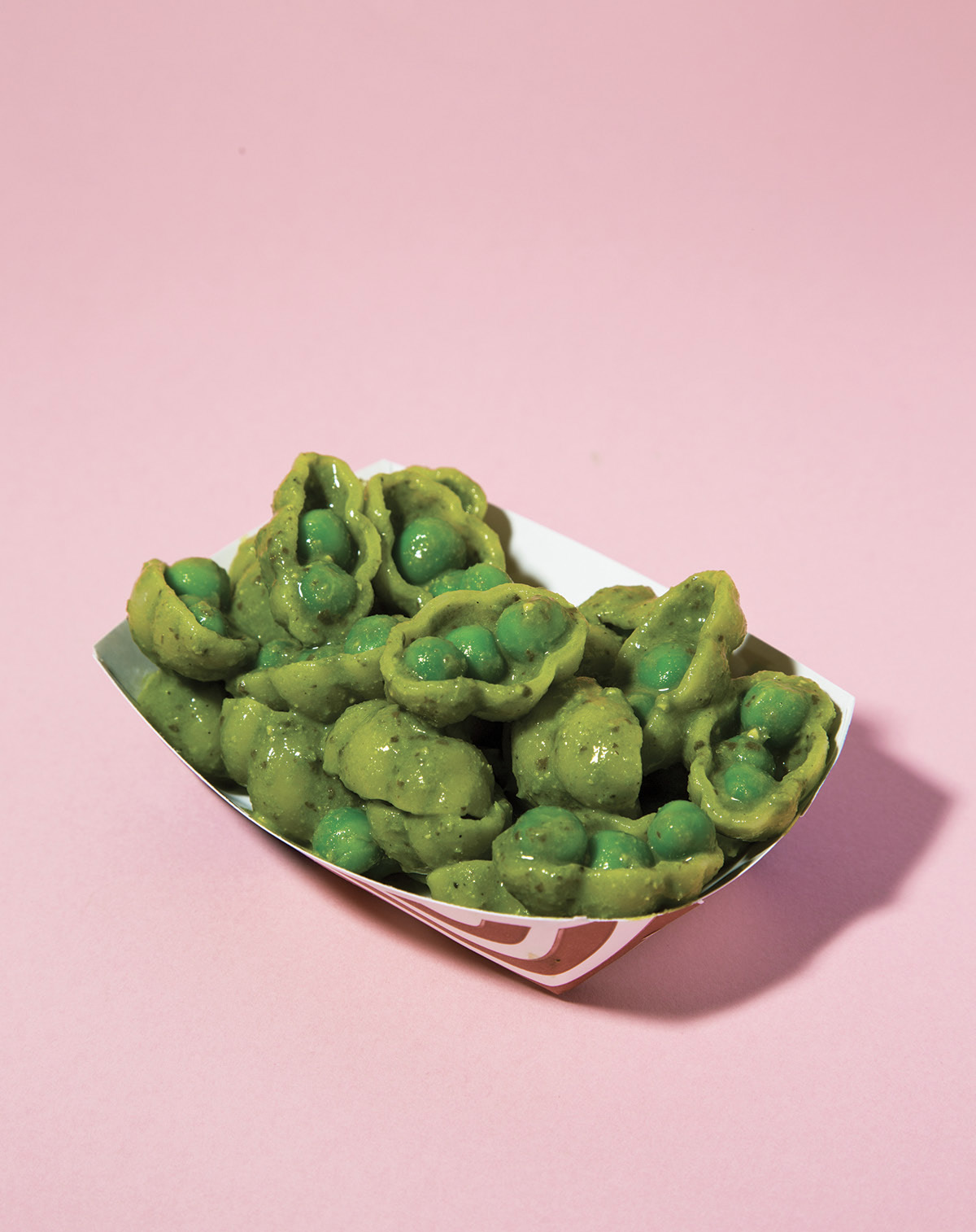
Who’re we to claim intellectual property on this one? This recipe wrote itself. This is the only time we are going to insist on freshly shelled peas that are straight from the greenmarket. Look for De Cecco gnocchi-shaped pasta. Its marsupial quality is key for the slam dunk of cuteness this dish will unleash.
Serves 6
6 cups packed basil leaves
1 garlic clove
½ cup marcona almonds, toasted and roughly chopped
1 cup extra virgin olive oil
1 pound shell-shaped pasta (we use gnocchi shape)
2 cups green peas, fresh or frozen (if fresh, blanched)
Bring a pot of salted water to a rolling boil. Prepare an ice bath. Blanch the basil leaves for only 5 seconds, until they turn bright green. Using a strainer or a spider, remove the leaves from the water and immediately plunge them into the ice bath. Save the blanching water. Drain quickly and squeeze dry in a clean kitchen towel. Transfer the basil to a blender and add the garlic clove, almonds, and olive oil and puree until a smooth sauce forms. Transfer to a bowl and season with salt and pepper.
In the pot of boiling water, cook the pasta until just shy of al dente. Immediately strain in a colander and then spread out the pasta on two flat sheet trays to cool as quickly as possible.
Combine the cooked pasta with the pesto and peas in a large bowl. Toss thoroughly so that the pesto really thickly coats all the pasta (inside and out) and the peas begin to find their way into the cavities of the shells. If the sauce is too thick, a squirt of water will make it creamy. Check the seasoning for salt and pepper and serve immediately.
ROASTED RUTABAGA WITH BROWN RICE AND POMEGRANATE MOLASSES
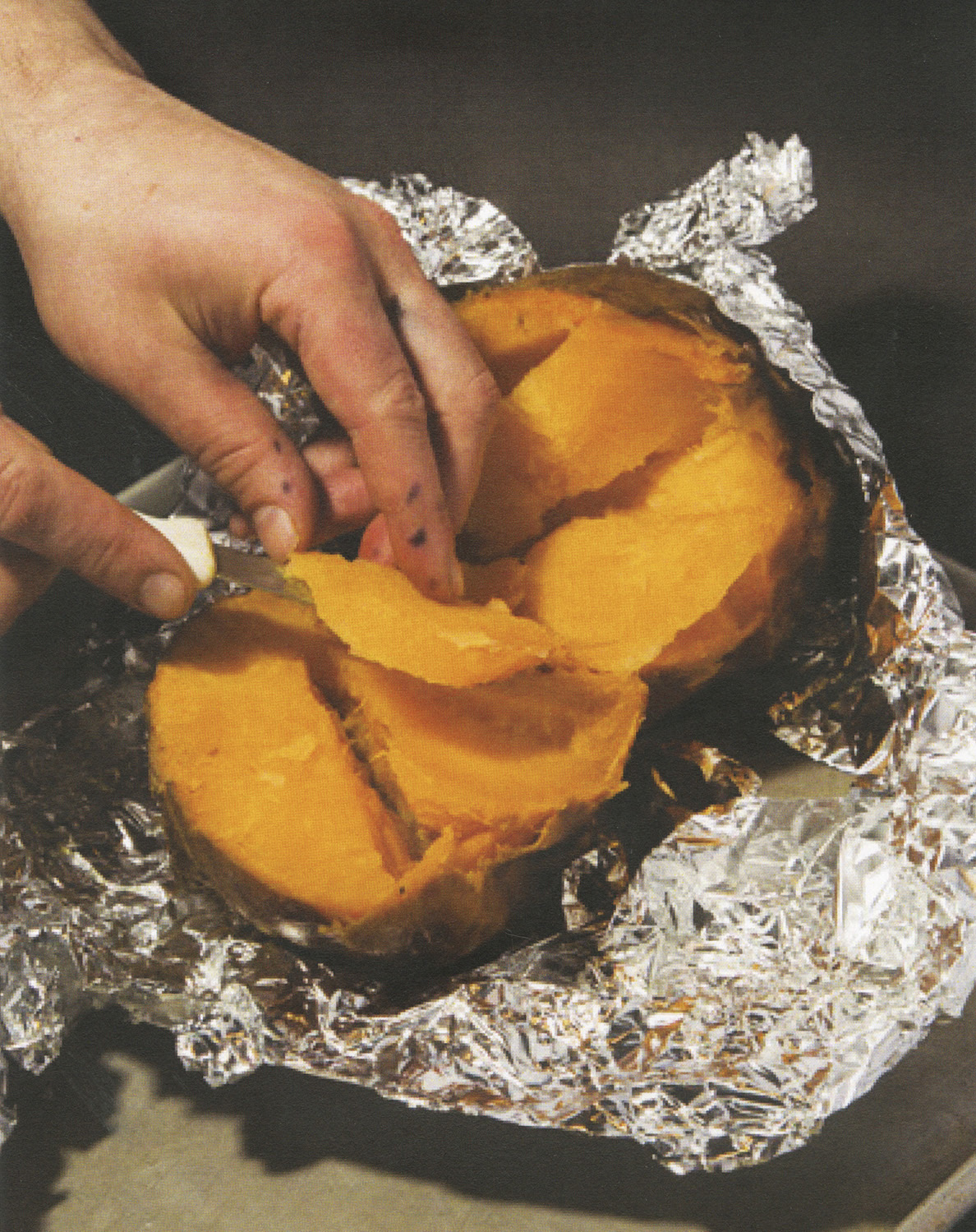
This was a midseason swap out for the smashed cucumber salad that no longer had greenmarket availability. Rutabagas are one of the only things regularly available at NYC greenmarkets all winter long, and long-cooked, very much a set-it-and-forget-it culinary act. But once they are done and still warm, you can squeeze them and a NY strip ooze of jus will be released from their vesicles. We cube some and mix it with labne and brown rice, saving a portion to shave last minute on top for an accidental Comté and/or clothbound Cheddar trompe l’oeil.
Serves 6
½ cup plain yogurt, labne, or vegan yogurt
2 tablespoons smooth tahini
Juice of 1 lemon
1 teaspoon maple syrup (optional)
½ cup pomegranate molasses
1 jalapeño chile, minced
2 large rutabagas, skin-on, whole
Extra virgin olive oil
2 cups cooked brown rice (page 211), warm or at room temperature
½ cup fresh cilantro (stems are okay), chopped
1 cup crushed toasted sesame breadsticks
Mix together the yogurt, tahini, and lemon juice in a medium bowl. Slowly add water, a tablespoon at a time, to make a loose and smooth dressing. Season with salt and black pepper and, if the tahini is particularly bitter, the maple syrup. In a small bowl, mix the pomegranate molasses with the minced jalapeño.
Preheat the oven to 375ºF.
Using your hands, coat the rutabagas with olive oil and wrap in aluminum foil. Roast until a knife can easily pierce the rutabagas, about 2 hours, maybe more if the rutabagas are large. Allow to cool in the foil. Once cooled, carefully chop 1½ rutabagas into 1-inch cubes, reserving the uncut portion.
Mix together the brown rice and rutabagas in a large bowl. Gradually add the yogurt dressing, being cautious not to drown the rice. Check for salt and black pepper. If the mixture seems too thick or gluey, add about a tablespoon of water and it should smooth out and become creamy. Add the chopped cilantro. Using a mandoline, slice the remaining rutabaga in thin shards that resemble irregular hunks of cheese, then add on top of the rice mixture. To serve, drizzle with a little of the spicy pomegranate molasses and a handful of the crushed breadsticks. Serve at room temperature or a little warmer.
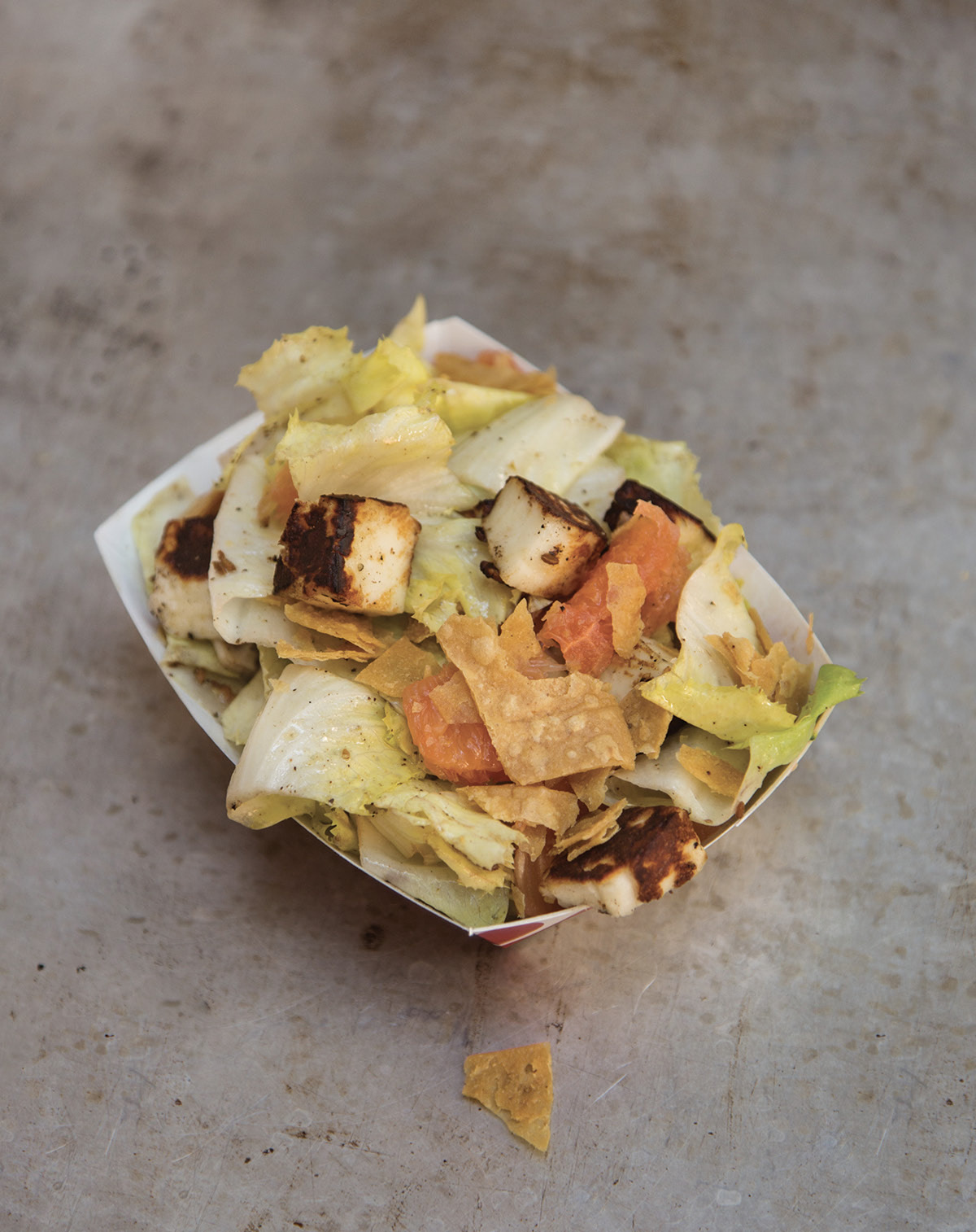
BITTER GREENS WITH GRAPEFRUIT, RE-TOASTED CORN CHIPS, AND HALLOUMI
Grapefruit is the chief flavor here. As a vinaigrette, it makes the greens taste hauntingly adult, which is crucial because the corn chips drag the whole mess back down to a junior high cantina. Even though there is not a speck of pork, pineapple, or raw onion at play in this salad, you get gently seduced by whispers of tacos al pastor.
Serves 6
Zest and juice of 3 limes
2 tablespoons seasoned rice wine vinegar
½ cup extra virgin olive oil
Grapeseed oil
One 8-ounce block halloumi cheese, cut into ½-inch cubes
2 large heads bitter greens (escarole, frisée, endive, etc.), torn into pieces
2 grapefruits, peel and pith removed, cut into suprêmes or segments
1 jalapeño chile, sliced paper thin with a mandoline
1½ cups crushed yellow corn chips, briefly re-toasted
Combine the lime zest, lime juice, and rice wine vinegar in a medium bowl. Whisk in the olive oil and add salt and black pepper.
In a large skillet over medium heat, add a few tablespoons of grapeseed oil. When the oil is shimmering, add the halloumi cubes and sear, turning frequently, until they are golden brown on at least two sides. Transfer to a small bowl.
In a large bowl, combine the bitter greens with some of the lime dressing and season again. Gently mix in the grapefruit pieces, jalapeño, grilled halloumi, and corn chips, making sure to evenly disperse everything throughout the greens. This salad should be eaten immediately.
Table of contents
- Cover
- Title
- Contents
- Introduction
- A Few Notes on These Recipes
- Sandwiches
-
Cool Salads
- Burnt Broccoli Salad
- Tahini Ranch Romaine Salad
- Caraway Slaw
- Chicories Salad
- Green Brown Rice with Yellow Beets
- Chopped Salad
- Wedgeless Wedge Salad
- Home-Style Potato Salad
- Corn and Tomatoes with Bruised Basil and Olive Oil Croutons
- Ice-Cold Herbed Melon and Cucumber Salad
- Fennel and Celery Salad with Spicy Peanut Sauce
- Okra Rice Salad
- Roasted Cauliflower with Tamarind, Shiso, and Peanuts
- Raw Swiss Chard Salad
- Iced and Smashed Cucumber Salad
- Vegetable Salad
- Sweet-and-Sour Red Beets with Cream Cheese and Fried Pretzels
- Kohlrabi Slaw
- Wild Rice Salad with Candied Hibiscus
- Stuffed Cabbage Salad
- Half-Wilted Escarole with Corn Bread and Roasted Apricots
- Peas and Pesto
- Roasted Rutabaga with Brown Rice and Pomegranate Molasses
- Bitter Greens with Grapefruit, Re-Toasted Corn Chips, and Halloumi
-
Warm Vegetables
- Griddled Broccoli Rabe
- Stuffed Green Peppers with Coconut and Iceberg
- Crunchy Potatoes
- Bean Toast
- Beer Batter Market Pancakes
- Loaded White Sweet Potato
- Roasted Orange Sweet Potato with Olive-Raisin Chutney
- Salt-and-Vinegar String Beans
- Kelp and Vegetable Scampi
- BBQ Baked Gigante Beans with Polenta and Coleslaw
- BBQ Carrots with Cashew Cream and Corn Chips
- Confit Potatoes
- Braised Collard Greens with Hot Sauce and Honey
- Griddled Yuba with Snap Peas, Rhubarb, and Mint
- Tahini-Roasted Cauliflower with Tangerines and Hazelnuts
- Garlic-Braised Escarole with Apples and Thyme
- Fried Rice and Beans
- Soups and Stews
- Sweets
-
Pantry Recipes
- Pump Cheese
- Pickled Onions and Other Alliums
- Fried Salt-and-Vinegar Wonton Wrappers
- Chile Oil
- Pickled Golden Raisins
- Cashew Cream
- Hammered Mushrooms
- Polenta Planks
- Cheesy Brined Tofu
- Pastrami Tofu
- Crunchy Potatoes
- Confit Potatoes
- Marinated Yuba Strips
- Brown Rice
- Corn Bread
- Chickpea Mayo
- Special Sauce
- Spicy Mayo
- Acknowledgments
- Glossary
- Index
- Copyright